|
 Industrial Standard Industrial Standard |
 |
| |
| Code for Management of Engineering Procurement Construction (EPC) Projects |
| 2019-06-12 |
 |
National Standards of People's Republic of China
Code for Management of Engineering Procurement Construction (EPC) Projects
GB/T 50358-2017
Editor-in-chief: Ministry of Housing snd Urban-Rural Development of the People's Republic of China
Approval department: Ministry of Housing snd Urban-Rural Development of the People's Republic of China
Effective date: January 1, 2018 |
Announcement of the Ministry of housing and urban rural development of the people's Republic of China
No. 1535
Announcement of the Ministry of housing and urban rural construction on the promulgation of the national standard "EPC contracting management standard for construction projects"
The EPC contracting management code for construction projects is approved as the national standard, No. GB / T 50358-2017, and shall be implemented as of January 1, 2018. The former national standard "EPC contract management code for construction projects" GB / T 50358-2005 shall be abolished at the same time.
This specification is published and issued by China Construction Industry Press organized by the Institute of standard quota of our ministry.
Ministry of Housing and Urban Rural Development of the People's Republic of China
May 4, 2017
|
Preface
This specification is compiled by the specification preparation group in accordance with the requirements of "notice on printing and distributing the plan for formulation and revision of engineering construction standards and specifications in 2014" (Jianbiao [2013] No.169) issued by the Ministry of housing and urban rural development, after extensive investigation and research, conscientiously summing up practical experience, referring to relevant international standards and foreign advanced standards, and on the basis of extensive soliciting opinions.
The main technical contents of this specification are: 1. General provisions; 2. Terms; 3. Organization of EPC contracting management; 4. Project planning; 5. Project design management; 6. Project procurement management; 7. Project construction management; 8. Project commissioning management; 9. Project risk management; 10. Project schedule management; 11. Project quality management; 12. Project cost management; 13. Project safety, occupational health and environment management; 14. Project resource management; 15. Project communication and information management; 16. Project contract management; 17. Project close-out.
The main technical contents of the revision of this specification are as follows: 1. The chapter "contents and procedures of EPC management" in the original specification is deleted, and the contents are explained in relevant chapters; 2. Two chapters of "project risk management" and "project close-out" are added; 3. The change management of relevant chapters of the original specification is unified into the chapter of project contract management.
This code is managed by the Ministry of housing and urban rural development, and the interpretation of specific technical contents is the responsibility of China Survey and Design Association. If you have any comments or suggestions during the implementation, please send them to China Association of survey and design (address: 13 / F, block a, Runfeng Deshang, 60 Anli Road, Chaoyang District, Beijing, postcode: 100101).
|
| Editor in chief: |
China Association of survey and design |
| Participants of this specification: |
China Huanqiu Engineering Co., Ltd
Sinopec Engineering Construction Co., Ltd
MCC Jingcheng Engineering Technology Co., Ltd
China Tianchen Engineering Co., Ltd
China National Petroleum Pipeline Engineering Co., Ltd
China Chengda Engineering Co., Ltd
China Haicheng Engineering Technology Co., Ltd
MCC saidI Engineering Technology Co., Ltd
North China Electric Power Design Institute Engineering Co., Ltd
Tianjin University
Tongji University
China United Engineering Corporation
China ENFI Engineering Technology Co., Ltd
China Railway Fourth Survey and Design Institute Group Co., Ltd
China Petroleum Engineering Construction Corporation
China Electronics Engineering Design Institute
Dadi engineering development (Group) Co., Ltd
China Construction Corporation Limited
Beijing Urban Construction Group Co., Ltd |
| Main drafters of this specification: |
Rong Shili, Li Sen, Zhang Xiudong, Cao Gang, Wang Chunguang, Li Chaojian, Li Jianqi, Fuhai, Ma Yunjie, Zhou Kewei, Zhang Zhizhang Shuibo, yueyun Wen, Zhenhua, Wang Guojiu, Quanquan, Wang Rui, Jiang Yuqin, Diao Xinqin, Li junsun Fubin, Chen Yonghua, Li Baodan, Qi Xiaoxi |
| Main reviewers of this specification: |
Xu chnong, Li Zhigao, Yuan Zongxi, Xia Wu, Wang Lin, you wan, Jia Hongjun, Xu Wengang, Zhu Xiaoquan, Zhang Weiguo, wanwangsheng, Shen huaiguo, Kangshi Qing |
|
Table of contents
1 General Provisions 1
2 Terms 2
3 Organization of EPC Contracting Management 6
3.1 General Regulations 6
3.2 Appointment of Project Manager and the Establishment of Project Management Team 6
3.3 Functions of the Project Management Team 7
3.4 Project management Team's Posts and Management 7
3.5 Project Manager's Competencies as Required 7
3.6 Project Manager's Duties and Powers 8
4 Project Planning 9
4.1 General Regulations 9
4.2 Content of Planning 9
4.3 Project Management Plan 10
4.4 Project Implementation Plan 10
5 Project design management 12
5.1 General Regulations 12
5.2 Design Plan 12
5.3 Design Implementation 13
5.4 Design Control 14
5.5 Design Close-out 15
6 Project Procurement Management 16
6.1 General Regulations 16
6.2 Procurement Procedure 16
6.3 Procurement Plan 16
6.4 Purchasing 17
6.5 Expediting and Inspection 18
6.6 Transportation and delivery 19
6.7 Procurement Change Management 20
6.8 Warehouse Management 20
7 Project Construction Management 21
7.1 General Regulations 21
7.2 Construction plan 21
7.3 Construction Schedule Control 22
7.4 Construction Cost Control 23
7.5 Construction Quality Control 23
7.6 Construction Safety Management 24
7.7 Construction Site Management 24
7.8 Construction change Management 25
8 Project Commissioning Management 26
8.1 General Regulations 26
8.2 Commissioning Management Plan 26
8.3 Implementation of Commissioning 27
9 Project Risk Management 29
9.1 General Regulations 29
9.2 Risk Identification 29
9.3 Risk Evaluation 29
9.4 Risk Control 30
10. Project Schedule Management 31
10.1 General regulations 31
10.2 Scheduling 31
10.3 Schedule Control 31
11 Project Quality Management 33
11.1 General Regulations 33
11.2 Quality Planing 33
11.3 Quality Control 34
11.4 Quality Improvement 34
12 Project Cost Management 35
12.1 General Regulations 35
12.2 Cost Estimation 35
12.3 Cost Plan 35
12.4 Cost Control 36
13 Project Safety, Occupational Health and Environment Management 37
13.1 General Regulations 37
13.2 Safety Management 37
13.3 Occupational Health Management 39
13.4 Environment Management 39
14 Project Resource Management 41
14.1 General Regulations 41
14.2 Human Resources Management 41
14.3 Equipment and Materials Management 41
14.4 Machine and tool Management 42
14.5 Technology Management 42
14.6 Fund Management 42
15 Project Communication and Information Management 44
15.1 General Regulations 44
15.2 Communication Management 44
15.3 Information Management 44
15.4 Document Management 45
15.5 Information Security and Confidentiality 45
16 Project Contract Management 46
16.1 General Regulations 46
16.2 EPC Contract Management 46
16.3 Subcontract Management 48
17 Project Close-out 51
17.1 General Regulations 51
17.2 Test and Acceptance on Completion 51
17.3 Payment Settlement on Project 51
17.4 Project Implementation Review 51
17.5 Performance Assessment and Audit 52
Explanation of terms used 53
Addition: Explanation of Provisions 55
Construction project EPC contracting management specifications (article description) 55
1 General Provisions 61
2 Term 62
3 Organization of EPC Contracting Management 68
4 Project Planning 70
5 Project Design Management 74
6 Project Procurement Management 78
7 Project Construction Management 83
8 Project Commissioning Management 87
9 Project Risk Management 89
10 Project Schedule Management 90
11 Project Quality Management 94
12 Project Cost Management 97
13 Project Safety, Occupational Health and Environment Management 100
14 Project Resource Management 103
15 Project Communication and Information Management 105
16 Project Contract Management 107
17 Close-out 110
|
| Code for Management of Engineering Procurement Construction (EPC) Projects |
1 General Provisions
1.0.1 This code is formulated with a view to improve the management level of Engineering Procurement Construction (EPC) Projects, promote the standardization of the management of Engineering Procurement Construction (EPC) Projects, and promote the integration of the management of Engineering Procurement Construction (EPC) Projects with international standards.
1.0.2 This code is applicable to the management of the whole process of design, procurement, construction and commissioning of construction projects by EPC enterprises and the project organization.
1.0.3 The management of Engineering Procurement Construction (EPC) Projects shall not only comply with this code, but also meet the requirements of the relevant national laws and regulations and compulsory standards. |
2 Terms
2.0.1 Engineering Procurement Construction (EPC) Contracting / Design-build Contracting
According to the contract, the design, procurement, construction and commissioning of the construction project shall be contracted in the whole process or several stages.
2.0.2 Project management team
Under the authorization and support of the legal representative of the EPC contracting enterprise, in order to achieve the project objectives, the project management organization is established and led by the project manager.
2.0.3 Project management
All activities to achieve the project objectives in the process of project implementation, including planning, organizing, monitoring and controlling all aspects of the project, and applying project management knowledge, skills, tools and techniques to project activities.
2.0.4 Project management system
In order to achieve project objectives and ensure the quality of project management, it is an organic whole composed of various elements of project management. It usually includes organization, responsibilities, resources, processes, procedures and methods. The project management system shall be documented.
2.0.5 Project initiation
An activity that formally approves the establishment of a project and entrusts it for implementation. The project manager shall be appointed and the project management team shall be established by the EPC contracting enterprise under the contract conditions.
2.0.6 Project management plan
Project management plan is an overall plan that integrates and coordinates the influences and requirements of all aspects of the project, and is the basis for guiding the implementation and management of the whole project.
2.0.7 Project implementation plan
Documents prepared according to the contract and approved project management plan and used for the management and control of project implementation.
2.0.8 Earned value
The budgeted cost for work performed, a criterion used to measure completion status of the projectthe schedule. Earned value has the dual characteristics of reflecting schedule and cost.
2.0.9 Project implementation
The process of implementing the project plan. The vast majority of the project budget will be consumed in the implementation process, and gradually to form the project products.
2.0.10 Project control
Through regular measurement and monitoring of project progress, determine the deviation between actual value and planned benchmark value, and take appropriate corrective measures to ensure the realization of project objectives.
2.0.11 Project close-out
The project was formally accepted and brought to an orderly conclusion. Project close-out includes contract close-out and project management closeout.
2.0.12 Design
The process of transforming the requirements of the project owner into the project product description. That is, the process of preparing design documents of construction projects according to contract requirements.
2.0.13 Procurement
The process of obtaining equipment, materials and services from the outside of the implementation organization to complete a project. Including the process of purchasing, expediting, inspection and transportation.
2.0.14 Construction
The process of transforming design documents into project products, including construction, installation, completion test, etc.
2.0.15 Commissioning
According to the contract, after the completion test of the project, the employer or the contractor of the project shall organize and carry out all the tests including the assessment and acceptance of the contract objectives.
2.0.16 Project scope management
Define, plan, control and change the work scope of the project agreed in the contract.
2.0.17 Project schedule control
A management activity to measure, analyze and forecast the progress and its deviation according to the schedule, or to take corrective measures or manage the schedule change in need.
2.0.18 Project cost management
A process needed to ensure the project to be completed within the approved budget. It mainly involves resource planning, cost estimation, cost budget and cost control.
2.0.19 Project cost control
Based on the cost budget plan, measure, analyze and forecast the cost and its deviation. If necessary, take corrective measures or manage the change of the cost budget (benchmark) plan.
2.0.20 Project quality plan
According to the quality standards agreed in the contract, providing measures to meet these standards, clarifying who and when, what procedures and related resources should be used.
2.0.21 Project quality control
In order to make the product quality of the project meet the requirements, during the implementation of the project, we should supervise the actual situation of the project quality, judge whether it meets the relevant quality standards, and analyze the causes of quality problems, so as to formulate corresponding measures to ensure the continuous improvement of project quality.
2.0.22 Project human resource management
Through the processes of organization planning, personnel acquisition and team development, to make the personnel participating in the project can be used most effectively.
2.0.23 Project information management
Collection, arrangement, analysis, processing, storage, transmission and use of project information.
2.0.24 Project risk
Due to the uncertainty of the environment and conditions of the project and the influence of the factors that the project stakeholders can not accurately predict or control subjectively, the final results of the project deviate from the expectations of the project stakeholders, and bring the possibility of losses to the project stakeholders.
2.0.25 Project risk management
The process of project risk identification, analysis, response and monitoring. It includes extending the impact probability of positive events to the maximum and reducing the impact probability of negative events to the minimum.
2.0.26 Project safety management
Manage the safety factors in the whole process of project implementation. Including the formulation of safety policies and objectives, planning and control of factors related to human, material and environmental safety in the process of project implementation.
2.0.27 Project occupational health management
Manage the occupational health factors in the whole process of project implementation. Including the formulation of occupational health policies and objectives, planning and controlling the occupational health of the project.
2.0.28 Project environmental management
In the process of project implementation, analyze, predict and evaluate the factors that may cause environmental impact, put forward countermeasures and measures to prevent or reduce adverse environmental impact, and carry out tracking and monitoring.
2.0.29 EPC Contract
The contract signed by the project contractor and the project employer for the whole process or several stages of contract for the design, procurement, construction and commissioning of the construction project.
2.0.30 Procurement contract
The supply contract signed between the project contractor and the supplier. A purchase contract can be called a purchase order.
2.0.31 Subcontract
The contract signed between the project contractor and the project subcontractor.
2.0.32 Defects Notification Period
The employer of the project has the right to inform the contractor of the time limit for repairing defects in the project from the delivery date agreed in the contract.
2.0.33 Maintenance period
According to the contract, the contractor of the project shall provide free repair and maintenance period for the products due to quality problems. |
3. Organization of EPC contracting management
3.1 General provisions
3.1.1 The EPC contracting enterprise should establish a management organization compatible with the EPC contracting project, and perform responsibilities of project management, adopt the project manager responsibility system.
3.1.2 The EPC contracting enterprise should adopt the form of the project management target responsibility letter, and clarify the project target and the responsibilities, authority and interests of the project manager.
3.1.3 The project manager shall implement the whole process management of the EPC contracting project from the start of the project to the end of the project in accordance with the scope and time authorized by the legal representative of the EPC contracting enterprise and the content specified in the project management target responsibility letter.
3.1.4 The EPC contracting enterprise should undertake EPC contracting of construction projects with matrix management. The project management team should be led by the project manager and accept the guidance, supervision, inspection and assessment of the functional departments of the EPC contracting enterprise.
3.1.5 The project management team shall be approved by the EPC contracting enterprise for dissolution after the completion of the project.
3.2 Appointing project manager and seting up project management team
3.2.1 The EPC contracting enterprise shall appoint a project manager after the EPC contract takes effect, and the legal representative of the EPC contracting enterprise shall issue a written power of attorney.
3.2.2 The establishment of the project management team should include the following main contents:
1. According to the management regulations of EPC contracting enterprise, combined with the characteristics of the project, determining the organizational form and seting up a project management team, and determining the functions of the project management team.
2. Determining the management scope and tasks of the project management team according to the EPC contract and the relevant management regulations of the EPC contracting enterprise.
3. Determining the composition, responsibilities and authority of the project management team.
4. The enterprise and the project manager sign the project management target responsibility letter.
3.2.3 The staffing and management regulations of the project management team should meet the management needs of EPC contracting project.
3.3 Functions of project management team
3.3.1 The project management team shall have the function of organizing, implementing and controlling the EPC contracting project.
3.3.2 The project management team shall be fully responsible for objectives of the quality, safety, cost, schedule, occupational health and environmental protection of the project.
3.3.3 The project management team shall have the internal and external communication, coordination and management functions.
3.4 Job setting and management of project management team
3.4.1 According to the scope of the EPC contract and the relevant regulations of the EPC contracting enterprise, the project management team can set up control manager, design manager, procurement manager, construction manager, commissioning manager, financial manager, quality manager, safety manager, business manager, administrative manager and other functional managers and schedule control engineer, quality engineer, safety engineer, contract management engineer, cost estimator, cost control engineer, materials control engineer, information management engineer and document management control engineer and other management positions. According to the specific conditions of the project, relevant positions can be adjusted..
3.4.2 The project management team should clarify the job responsibilities
3.5 Project manager qualifications
3.5.1 The EPC contracting enterprise of the project should clarify the ability requirements of the project manager, confirm the qualifications of the project manager, and manage it.
3.5.2 The project manager of the EPC contracting should have the following qualifications:
1. Obtaining a registered practice qualification or senior professional technical title for engineering construction.
2. Possessing decision-making, organization, leadership and communication skills, and be able to correctly handle and coordinate the relationships with owners, related parties, and various disciplines and departments of the enterprise.
3. Possess knowledges of project management of EPC contracting and relevant economics, laws and regulations.
4. Having management experience in similar projects.
5. Having good professional ethics.
3.6 Responsibilities and authority of the project manager
3.6.1 The project manager shall perform the following duties:
1. Implementing the management system of EPC contracting enterprises, and safeguard the legitimate rights and interests of enterprises.
2. Organizing and implementing project management of EPC contracting on behalf of the enterprise, and responsible for achieving the project objectives stipulated in the contract.
3. Completing the tasks specified in the project management target responsibility letter.
4. Responsible for coordinating with the owner, subcontractor and other project stakeholders within the scope of authorization, to solve problems arising in project implementation.
5. Planning, organizing, coordinating and controlling the whole process of project implementation.
6. Responsible for organizing and handling management closing and contract closing works of project.
3.6.2 The project manager should have the following authorities:
1. Authorized to set up the project management team, propose the organization of the project management team, select the members of the project management team, and determine the responsibilities of the personnel of the project management team.
2. Within the scope of authorization, exercising the corresponding management rights, performing corresponding duties.
3. Within the scope of the contract, it has the right to use the relevant resources of the EPC contracting enterprise in accordance with the prescribed procedures.
4. Approving the release of project management procedures.
5. Coordinating and handling internal and external matters related to the project.
3.6.3 The project management objective responsibility statement should include the following main contents:
1. Specify goals of project quality, safety, cost, schedule, occupational health and environmental protection, etc.;
2. Clarify the responsibilities, authorities and interests of the project manager;
3. Clarify the resources required by the project and the resource conditions provided by the EPC contractor for the project;
4. Principles, content and methods of project management objective evaluation;
5. The basis, standards and regulations of rewards and punishments for project management team personnel by the EPC contracting enterprise of the project;
6. The dismissal conditions and methods of the project manager and the project management team;
7. Matters entrusted by the legal representative of the enterprise to the project manager outside of the provisions of the EPC contracting enterprise system. |
4 Project planning
4.1 General provisions
4.1.1 The project management team should carry out project planning at the initial stage of the project, and prepare project management plans and project implementation plans.
4.1.2 Project planning should combine the characteristics of the project, clarify the project objectives and scope of work, analyze the project risks and the response measures taken, and determine the principles, measures and processes of the project managements in accordance with the requirements of the contract and the management of the EPC contracting enterprise.
4.1.3 The scope of project planning should cover all elements involved in the entire process of project activities.
4.1.4 According to the scale and characteristics of the project, the project management plan and the project implementation plan can be combined into a project plan.
4.2 Content of project planning
4.2.1 Project planning should meet contract requirements. At the same time, it should meet the requirements of the project location for the social environment, supporting conditions, project stakeholders, and the project's requirements for technology, quality, safety, cost, schedule, occupational health, environmental protection, relevant policies, laws and regulations.
4.2.2 Project planning should include the following main contents:
1. Clarify project planning principles;
2. Clarify the goals of the project technology, quality, safety, cost, schedule, occupational health and environmental protection, and formulate relevant management procedures;
3. Determine the project management model, organization and division of responsibilities;
4. Develop a resource allocation plan;
5. Develop project coordination procedures;
6. Develop a risk management plan;
7. Develop a subcontracting plan.
4.3 Project management plan
4.3.1 The project management plan should be compiled by the project manager and approved by the relevant person in charge of the EPC contracting enterprise.
4.3.2 The main basis for the preparation of the project management plan shall include the following main contents:
1. Project contract;
2. Requirements of the project developer and other project stakeholders;
3. Project status and implementation conditions;
4. Information and materials provided by the project developer;
5. Relevant market information;
6. The overall requirements of the management of the EPC contracting enterprise.
4.3.3 The project management plan shall include the following main contents:
1. Project overview;
2. Project scope;
3. Project management objectives;
4. Analysis of project implementation conditions;
5. Project management mode, organization and division of responsibilities;
6. Basic principles of project implementation;
7. Project coordination procedures;
8. Project resource allocation plan;
9. Project risk analysis and countermeasures;
10. Contract management.
4.4 Project Implementation Plan
4.4.1 The project implementation plan shall be organized and compiled by the project manager and approved by the project developer.
4.4.2 The preparation basis of the project implementation plan should include the following main contents:
1. Project management plan after approval;
2. Project management target responsibility letter;
3. Basic information of the project.
4.4.3 The project implementation plan should include the following main contents:
1. Overview;
2. Overall implementation plan;
3. Key points of project implementation;
4. The preliminary project schedule, etc.
4.4.4 The management of the project implementation plan shall meet the following requirements:
1. The project implementation plan should be signed by the project manager and approved by the project developer;
2. When the project developer raises an objection to the project implementation plan, the project manager can modify it after consultation;
3. The project management team shall dynamically monitor the execution of the project implementation plan;
4. After the completion of the project, the project management team shall analyze and evaluate the preparation and execution of the project implementation plan, and organize and file the evidence of related activities.
|
5 Project design management
5.1 General regulations
5.1.1 The design of EPC contracting projects should be undertaken by enterprises with corresponding design qualifications and capabilities.
5.1.2 The design should meet the technical performance, quality standards and requirements of the construction, operability and maintainability of the project as agreed in the contract.
5.1.3 The design manager should be in charge of design management, and the project design team should be formed in a timely manner. In the process of project implementation, the design manager should accept the management of the project manager and the design management department of the EPC contracting enterprise.
5.1.4 Procurement shall be included in the design procedure for EPC contracting projects. The design team shall be responsible for the preparation of requisition documents, technical review and technical negotiation of quotations, and review and confirmation of supplier drawings and documents.
5.2 Design plan
5.2.1 The design plan should be organized and compiled by the design manager or project manager, and approved by the project manager for implementation after review by the relevant functional departments of the EPC contracting enterprise.
5.2.2 The basis for the preparation of the design plan shall include the following main contents:
1. Contract documents;
2. Relevant approval documents of this project;
3. Project plan;
4. Specific characteristics of the project;
5. Relevant regulations and requirements of the country or industry;
6. Relevant requirements of the management system of EPC contracting enterprises.
5.2.3 The design execution plan should include the following main contents:
1. Design basis;
2. Design scope;
3. Design principles and requirements;
4. Organizational structure and division of responsibilities;
5. List of applicable standard specifications;
6. Quality assurance procedures and requirements;
7. Schedule plan and main control points;
8. Technical and economic requirements;
9. Requirements of safety, occupational health and environmental protection;
10. Interface relationship with procurement, construction and commissioning and requirements.
5.2.4 The design plan shall meet the quality objectives and requirements stipulated in the contract, and at the same time shall meet the quality management system requirements of the EPC contracting enterprise.
5.2.5 The design plan should clarify the project cost control indicators and design man-hour indicators, and it is advisable to establish a measurement benchmark for the project design execution effect.
5.2.6 The design schedule should meet the requirements of the overall project schedule, meet the internal logic of the design work, resource allocation, external constraints and other conditions, and be consistent with the schedule of engineering survey, procurement, construction and commissioning.
5.3 Design implementation
5.3.1 The design team shall implement the approved design plan to meet the requirements of the plan control objectives.
5.3.2 The design manager shall organize the inspection and verification of the basic design data and information.
5.3.3 The design team shall coordinate and manage the design in accordance with the project coordination procedures, and coordinate and control the interface relationship between the various disciplines in accordance with the relevant professional condition management regulations of the EPC contracting enterprise.
5.3.4 The design team shall conduct design review in accordance with the project design review procedures and plans, and save the evidence of the results of the review activities.
5.3.5 The design team should make an orderly connection with procurement and construction according to the design plan and handle the interface relationship.
5.3.6 The preliminary design documents shall meet the requirements of the main equipment and materials ordering and the preparation of construction drawing design documents; the construction drawing design documents shall meet the requirements of equipment and material procurement, non-standard equipment production and construction, and commissioning.
5.3.7 The design and selection of equipment and materials should indicate their specifications, models, performance, quantity and other technical indicators in the design documents, and their quality requirements should meet the contract requirements and the relevant provisions of the current relevant national standards.
5.3.8 Before construction, the project management team should organize design briefing or training.
5.3.9 The design team shall undertake the technical support and services in the construction and commissioning phases in accordance with the contract.
5.4 Design Control
5.4.1 The design manager should organize and inspect the implementation of the design plan, analyze the progress deviation, and formulate effective measures. The control points of the design progress should include the following main contents:
1. The conditional relationship and progress among various disciplines of design;
2. Completion and submission time of preliminary design;
3. Time for submission of purchase documents for key equipment and materials;
4. The time when the design team receives the final technical data from the equipment and material suppliers;
5. Time for submission of design documents on critical routes of progress;
6. Time for completion and submission of construction drawing design;
7. End time of design work.
5.4.2 The design quality should be controlled in accordance with the requirements of the project quality management system, and control measures should be formulated. The design manager and the persons in charge of each discipline should fill in the required quality records and feed back the project design quality information to the functional department of the EPC contracting enterprise. Design quality control points should include the following main contents:
1. Management of the qualifications of designers;
2. Control of design input;
3. Control of design planning;
4. Evaluation of the design technical plan;
5. Review and countersignature of design documents;
6. Control of design output;
7. Control of design confirmation;
8. Control of design changes;
9. Design technical support and service control.
5.4.3 The design team shall conduct design change management in accordance with the contract change procedure.
5.4.4 Design changes shall provide requirements on technology, quality, safety and quantity of materials.
5.4.5 The design team shall count the quantity of equipment and materials according to the equipment and material control procedures, and submit purchase documents. The purchase document should include the following main contents:
1. Purchase requisition;
2. Specifications and data sheets of equipments and materials;
3. Design drawings;
4. Applicable standards and specifications;
5. Other relevant information and documents.
5.4.6 The design manager and the person in charge of each discipline shall cooperate with the control personnel to conduct comprehensive inspection and trend forecast of design cost, analyze the causes of deviation, and propose corrective measures.
5.5 Design finalization
5.5.1 The design manager and the person in charge of each profession shall, in accordance with the requirements of the design execution plan, not only submit the design documents as required by the contract, but also complete the relevant documents required for closing the contract.
5.5.2 The design manager and the person in charge of each profession shall collect and organize the design drawings, materials and related records according to the project document management regulations, organize the compilation and archive of the project design document catalog.
5.5.3 The design manager shall organize the preparation of the design completion report, participate in the preparation of the project completion report, and feed back the experience and lessons of project design to the relevant functional departments of the EPC contracting enterprise. |
6 Project procurement management
6.1 General provisions
6.1.1 The procurement manager should be in charge of project procurement management, and the project procurement team should be organized in a timely manner. In the process of project implementation, the procurement manager shall accept the management of the project manager and the procurement management department of the EPC contracting enterprise.
6.1.2 The procurement work shall obtain the required equipment, materials and related services in accordance with the technical, quality, safety, schedule and cost requirements of the project.
6.1.3 The EPC contractor of the project should pre-qualify the suppliers.
6.2 Procurement procedures
6.2.1 The procurement work shall be implemented according to the following procedures:
1. According to the project procurement plan, prepare the project procurement execution plan;
2. purchase;
3. Expediting the ordered equipment, materials, drawings and documents;
4. Inspect according to the contract;
5. Transportation and delivery;
6. Warehouse management;
7. On-site service management;
8. End of purchase.
6.2.2 The procurement team can adjust the procurement procedures and content according to the needs of the procurement work, and should meet the requirements of the project contract.
6.3 Procurement plan
6.3.1 The procurement plan should be organized by the procurement manager and implemented after approval by the project manager.
6.3.2 The basis for preparing the procurement plan shall include the following main contents:
1. Project contract;
2. Project management plan and project implementation plan;
3. Project schedule;
4. Procurement management procedures and regulations for EPC contracting enterprises.
6.3.3 The procurement plan shall include the following main contents:
1. Preparation basis;
2. Project overview;
3. Purchasing principles include the division strategy and management principles of contract packages, the control principles of technology, quality, safety, cost and schedule, the principles of equipment and material distribution, etc.;
4. Scope and content of procurement work;
5. Purchasing positions and their main responsibilities;
6. The main control objectives and requirements of the procurement schedule, the implementation plan for the special procurement of long-term equipment and special materials;
7. Plans for expediting, inspection, transportation and material control;
8. The main objectives, requirements and measures of procurement cost control;
9. The main objectives, requirements and measures of procurement quality control;
10. Procurement coordination procedures;
11. Principles for handling special procurement matters;
12. On-site procurement management requirements.
6.3.4 The procurement team shall carry out its work according to the procurement plan. The procurement manager shall manage and monitor the implementation of the procurement plan.
6.4 Purchase
6.4.1 Purchasing work should include the receipt of purchase requisition documents, determination of purchase methods, implementation of purchases, and signing of purchase contracts or orders.
6.4.2 The procurement team shall organize the purchasing work in accordance with the approved procurement documents.
6.4.3 The qualified supplier of the project shall meet the following basic conditions at the same time:
1. Meet the corresponding qualification requirements;
2. Ability to meet the technical requirements of product design;
3. Ability to meet product quality requirements;
4. Meet the requirements of quality, occupational health and safety and environmental management systems;
5. Have a good reputation and financial status;
6. Ability to ensure timely delivery according to contract requirements;
7. Have a good after-sales service system.
6.4.4 The purchasing engineer shall implement the purchasing according to the purchasing method determined in the procurement plan.
6.4.5 According to the authorization of the EPC contracting enterprise of the project, the project manager or procurement manager can sign the procurement contract or order with the supplier according to the regulations. The procurement contract or order should be complete, accurate, strict and legal, and should include the following main contents:
1. The body of the procurement contract or order and its attachments;
2. Technical requirements and supplementary documents;
3. Quotation documents;
4. Minutes of the meeting;
5. Written documents involving changes in business and technical content.
6.5 Expediting and Inspection
6.5.1 The procurement manager shall organize relevant personnel to classify expediting and inspection levels according to the importance of equipment and materials, determine expediting and inspection methods and frequency, formulate expediting and inspection plans and organize their implementation.
6.5.2 The expediting methods should include expediting in the factory, expediting in the office, expediting in the meeting, etc.
6.5.3 The expediting work should include the following main contents:
1. Familiar with procurement contracts and accessories;
2. According to the expediting level of equipment and materials, formulate expediting plan and clarify the main inspection contents and control points;
3. Require suppliers to provide manufacturing schedules on time and provide schedule reports on a regular basis;
4. Check that the progress of equipment and material manufacturing, and the supplier's submission of drawings and documents meets the requirements of the procurement contract;
5. Supervise the supplier to submit effective drawings and documents for design review and confirmation as planned, and ensure that the confirmed drawings and documents are returned to the supplier on time;
6. Check the preparation of the transportation plan and freight documents, and expedit the final documents agreed in the contract;
7. Prepare a report on the expediting status as required.
6.5.4 According to the purchase contract, the purchasing team shall organize qualified inspectors in accordance with the inspection plan, determine the inspection method according to the requirements of the design documents and standard specifications, and conduct inspections during the manufacturing process of equipment and materials and before leaving the factory. Important and key equipment should be supervised in the factory.
6.5.5 For equipment and materials with special requirements, an inspection contract can be signed with a third-party inspection unit with corresponding qualifications and capabilities, and the inspection can be commissioned. The inspection personnel of the purchasing team shall supervise and control the inspection work of the third party in accordance with the contract. When there is an agreement in the contract, the project developer shall be arranged to participate in the relevant inspection.
6.5.6 Inspectors should prepare in-plant manufacturing supervision and factory inspection reports as required. The inspection report should include the following main contents:
1. Contract number, name, specification and quantity of inspected equipment and materials;
2. Supplier’s name, inspection location and start and end time;
3. Participants of all parties;
4. The control status of inspection, measurement and test equipment used by the supplier shall be accompanied by relevant records;
5. Inspection records;
6. Quality inspection report issued by the supplier;
7. Inspection conclusion.
6.6 Transportation and delivery
6.6.1 The procurement team shall formulate and implement the equipment and material transportation plan according to the delivery conditions agreed in the procurement contract. The content of the plan should include preparations before transportation, transportation time, transportation methods, transportation routes, personnel arrangements, and cost plans.
6.6.2 The procurement team shall supervise and manage the packaging and transportation process in accordance with the procurement contract.
6.6.3 For the transportation of equipment that exceeds the limit and has special requirements, the procurement team shall formulate a special transportation plan, which can be entrusted to a special transportation agency.
6.6.4 For international transportation, it should be carried out in accordance with the procurement contract, international conventions and conventions, and complete the procedures for customs declaration, commodity inspection and insurance.
6.6.5 The procurement team shall ascertain the conditions for receiving goods, prepare unloading plans, and do a good job of receiving goods on site.
6.6.6 After the equipment and materials are delivered to the designated location, the receiving personnel shall check the delivery note, sign for receipt, indicate the arrival status and completeness of the equipment and materials, and fill in the receipt report and file it.
6.7 Procurement Change Management
6.7.1 The project management team shall carry out procurement change management in accordance with contract change procedures.
6.7.2 According to the content of the contract change and the procurement requirements, the procurement team should predict the relevant expenses and schedule, and should cooperate with the project management team to implement and control.
6.8 Warehouse management
6.8.1 The project management team should set up storage management personnel on the construction site to be responsible for storage management.
6.8.2 Before the equipment and materials are officially put into storage, the unpacking inspection shall be organized according to the contract.
6.8.3 If the equipment and materials that pass the unpacking inspection meet the required storage conditions, an application for storage should be submitted and the storage procedures should be completed.
6.8.4 Warehousing management should include material receiving, custody, inventory and distribution, as well as management of technical files, bills, accounts and warehousing security. Warehousing management should establish a dynamic detailed ledger of materials, and all materials should be marked with the location, file number and identification code, etc. The warehouse manager should post the account and check it regularly to make the account match.
6.8.5 The procurement team shall develop and implement a material distribution system, issue equipment and materials according to the approved material requisition form, and go through the material delivery and handover procedures. |
7 Project construction management
7.1 General provisions
7.1.1 The construction of EPC contracting projects shall be undertaken by enterprises with corresponding construction qualifications and capabilities.
7.1.2 The construction manager should be responsible for the construction management, and the construction team should be formed in a timely manner. In the process of project implementation, the construction manager should accept the management of the project manager and the construction management department of the EPC contracting enterprise.
7.2 Construction plan
7.2.1 The construction plan should be organized and compiled by the construction manager, organized and implemented after being approved by the project manager, and reported to the project developer for confirmation.
7.2.2 The construction plan should include the following main contents:
1. Project overview;
2. Principles of construction organization;
3. Construction quality plan;
4. Construction safety, occupational health and environmental protection plan;
5. Construction schedule;
6. Construction cost plan;
7. Construction technology management plan, including construction technology plan requirements;
8. Resource supply plan;
9. Requirements for construction preparation work.
7.2.3 When subcontracting is adopted for construction, the project developer shall specify the scope of subcontracting and the responsibilities and obligations of the project subcontractor in the construction plan.
7.2.4 The construction team shall implement target tracking and supervision management of the construction plan, and shall perform the approval procedures for major changes in the engineering design and construction plan that occur during the construction process.
7.3 Construction progress control
7.3.1 The construction team shall organize the preparation of the construction schedule according to the construction plan, and organize the implementation and control.
7.3.2 The construction schedule should include the overall construction schedule, the individual project schedule and the unit project schedule. The overall construction schedule should be reported to the project developer for confirmation.
7.3.3 The basis for compiling the construction schedule should include the following main contents:
1. Project contract;
2. Construction execution plan;
3. Construction progress target;
4. Design documents;
5. Construction site conditions;
6. Supply plan;
7. Relevant technical and economic information.
7.3.4 The construction schedule should be prepared according to the following procedures:
1. Collect the compilation basis data;
2. Determine the progress control target;
3. Calculate the engineering quantity;
4. Determine the construction period of the branch, sub-item and unit project;
5. Determine the construction process;
6. Form the construction schedule;
7. Prepare the construction schedule plan specification.
7.3.5 The construction team shall establish a management mechanism for tracking, supervision, inspection and reporting of the construction progress.
7.3.6 The construction team should check the implementation of key routes and resource allocation in the construction schedule, and submit a construction progress report. The construction team should adopt technologies such as earned value to measure construction progress, analyze progress deviations, predict progress trends, and take corrective measures.
7.3.7 When the construction schedule is adjusted, the project management team shall coordinate and confirm according to the prescribed procedures, and keep relevant records.
7.4 Construction cost control
7.4.1 The construction team shall estimate the construction cost and determine the construction cost control benchmark according to the project construction plan. When the construction cost control benchmark is adjusted, it shall be approved in accordance with the prescribed procedures.
7.4.2 The construction team should adopt technologies such as earned value to measure construction costs, analyze cost deviations, predict cost trends, and take corrective measures.
7.4.3 The construction team shall formulate a construction subcontracting fee payment plan and management regulations based on the construction subcontract, safety production management agreement and construction schedule.
7.5 Construction quality control
7.5.1 The construction team shall supervise the quality of the construction process, identify and control the special processes and key procedures, and keep quality records.
7.5.2 The construction team shall re-inspect the quality of the supply in accordance with the regulations and save the evidence of the activity results.
7.5.3 The construction team shall supervise the disposal of unqualified construction products and verify the implementation effect.
7.5.4 The construction team shall conduct validity and safety inspections on the configuration and use status of required construction machinery, equipment, facilities, tools and appliances, and conduct tests when necessary. Operators should hold certificates to work, operate in accordance with operating procedures, and perform maintenance and repair during use.
7.5.5 The construction team shall analyze and evaluate the quality control performance of the construction process, clarify the improvement goals, formulate corrective measures, and carry out continuous improvement.
7.5.6 The construction team should clarify the construction quality standards and control objectives according to the construction quality plan.
7.5.7 The construction team shall organize the review of the construction organization design and special construction plan of the project subcontractor.
7.5.8 The construction team shall organize or participate in the project quality acceptance as required.
7.5.9 When implementing construction subcontracting, the project management team shall organize the project subcontractor to complete and submit quality records and completion documents according to the construction subcontract agreement, and conduct review.
7.5.10 When a quality accident occurs during construction, it should be dealt with in accordance with the current relevant national regulations.
7.6 Construction Safety Management
7.6.1 The project management team should establish a project safety production responsibility system to clarify the responsibilities, scope of responsibility and assessment standards of the personnel in each position.
7.6.2 The construction team shall carry out safety planning during the construction phase according to the project safety management implementation plan, prepare a construction safety plan, establish a construction safety management system, clarify safety responsibilities, and implement construction safety management objectives.
7.6.3 The construction team shall organize on-site safety inspections in accordance with the safety inspection system, master safety information, hold regular safety meetings, and discover and eliminate hidden dangers.
7.6.4 The construction team shall be responsible for construction safety management and implement unified coordination, supervision and control.
7.6.5 The construction team shall identify and analyze the hazards at various stages, positions and locations of the construction, formulate countermeasures, and implement management and control.
7.6.6 According to the contract, the EPC contractor or subcontractor must participate in work-related injury insurance in accordance with the law, pay insurance premiums for employees, and encourage production safety liability insurance.
7.6.7 The construction team shall establish and keep complete construction records.
7.6.8 The project management team should clarify their respective safety production management responsibilities and safety measures to be taken in accordance with the subcontract and safety production management agreement, and designate full-time safety production management personnel to conduct safety production management and coordination.
7.6.9 The EPC contracting enterprise shall establish a supervision and management mechanism. Supervise and assess the implementation of the safety production responsibility system of the project management team.
7.7 Construction site management
7.7.1 The construction team shall, in accordance with the requirements of the construction plan, carry out various preparations before the start of construction, coordination and management during the construction process.
7.7.2 The project management team shall establish a project environmental management system, master the monitoring environmental information, and take countermeasures.
7.7.3 The project management team shall establish and implement a safety precaution and public security management system, implement the scope of prevention and responsibility, and check the adaptability and effectiveness of the alarm and rescue system.
7.7.4 The project management team shall establish a construction site sanitation and epidemic prevention management system.
7.7.5 When a safety accident occurs at the scene, it should be dealt with in accordance with the current relevant national regulations.
7.8 Construction Change Management
7.8.1 The project management team shall carry out construction change management in accordance with contract change procedures.
7.8.2 The construction team shall evaluate the impact of quality, safety, cost, schedule, occupational health and environmental protection according to the content of contract changes and construction requirements, and shall cooperate with the project management team to implement and control. |
8 Project commissioning management
8.1 General provisions
8.1.1 The project management team shall conduct project commissioning management and service in accordance with the contract.
8.1.2 The commissioning management of the project is in charge of the commissioning manager, and the commissioning team shall be formed in due course. In the commissioning management and service process, the commissioning manager shall accept the management of the project manager and the commissioning management department of the EPC contracting enterprise.
8.1.3 According to the contract, the commissioning management content may include the preparation of the commissioning execution plan, commissioning preparation, personnel training, commissioning process guidance and services, etc.
8.2 Commissioning Plan
8.2.1 The commissioning execution plan shall be organized by the commissioning manager, and be organized and implemented after approval by the project manager and confirmation by the project developer.
8.2.2 The commissioning execution plan shall include the following main contents:
1. General description;
2. Organization;
3. Schedule;
4. Resource plan;
5. Expense plan;
6. Training plan;
7. Assessment plan;
8. Quality, safety, occupational health and environmental protection requirements;
9. Requirements for preparation of commissioning documents;
10. Preparation requirements for commissioning;
11. The division of responsibilities between the project developer and related parties, etc.
8.2.3 The commissioning execution plan should be arranged according to the characteristics of the project, the content, procedures and cycle of the commissioning.
8.2.4 The training plan should be prepared in accordance with the contract and the characteristics of the project, and implemented after being approved by the project developer. The training plan should include the following main contents:
1. Training objectives;
2. Training positions;
3. Training personnel and time arrangement;
4. Training and assessment methods;
5. Training location;
6. Training equipment;
7. Training costs;
8. Training content and teaching materials, etc.
8.2.5 The assessment plan should be prepared in accordance with the contractual objectives, assessment content and project characteristics. The assessment plan should include the following main contents:
1. The name of the assessment item;
2. Assessment indicators;
3. Division of responsibilities;
4. Assessment method;
5. Means and methods;
6. Assessment time;
7. Detection or measurement;
8. Laboratory equipment and tools;
9. Evaluation and confirmation of assessment results.
8.3 Implementation of Commissioning
8.3.1 The commissioning manager shall be responsible for organizing or assisting the project developer to prepare the commissioning plan in accordance with the contract. The commissioning plan should include the following main contents:
1. Project overview;
2. Compilation basis and principles;
3. Goals and adoption standards;
4. Conditions for commissioning;
5. Organizational command system;
6. Schedule of commissioning;
7. Trial run resource allocation;
8. Arrangements for commissioning of environmental protection facilities;
9. Safety and occupational health requirements;
10. The expected technical difficulties and countermeasures for the commissioning.
8.3.2 The project management team shall cooperate with the project contractor to prepare for commissioning, and ensure that the construction, installation and commissioning of the production system, supporting systems and auxiliary systems are completed in accordance with the design documents and relevant standards.
8.3.3 The commissioning manager shall implement relevant technologies, personnel and materials in accordance with the requirements of the commissioning execution plan and program.
8.3.4 The commissioning manager shall organize the inspection of the problems that affect the achievement of the contract target evaluation and implement the solutions.
8.3.5 The time and period of contract objective assessment shall be implemented in accordance with the contract and the assessment plan. During the assessment period, when all guaranteed values meet the standard, the representatives of both parties to the contract shall sign the contract target assessment qualification certificate individually or in a unified manner.
8.3.6 According to the contract, the content of training services may include theoretical training, simulation training and practical operation training for production management and operating personnel.
|
9. Project Risk Management
9.1 General provisions
9.1.1 The EPC contractor of the project shall formulate risk management regulations and clarify the responsibilities and requirements of risk management.
9.1.2 The project management team should prepare project risk management procedures, clarify project risk management responsibilities, and be responsible for the organization and coordination of project risk management.
9.1.3 The project management team shall formulate a project risk management plan and determine the project risk management objectives.
9.1.4 Project risk management should run through the entire process of project implementation, and dynamic management should be carried out in stages.
9.1.5 Applicable methods and tools should be adopted for project risk management.
9.1.6 The project EPC contracting enterprise can establish and improve the project risk database and project risk loss event database by summarizing the project risk events that have occurred.
9.2 Risk identification
9.2.1 The project management team shall, on the basis of project planning, identify risks in the design, procurement, construction and commissioning phases in accordance with contractual agreements, form a project risk identification list, and output the project risk identification results.
9.2.2 The project risk identification process should include the following main contents:
1. Identify project risks;
2. Classify project risks;
3. Output project risk identification results.
9.3 Risk assessment
9.3.1 The project management team shall conduct project risk assessment on the basis of project risk identification and output the assessment results.
9.3.2 The project risk assessment process should include the following main contents:
1. Collect project risk background information;
2. Determine the project risk assessment standards;
3. Analyze the probability and causes of project risks, and guess the consequences;
4. Use applicable risk evaluation methods to determine the overall risk level of the project;
5. Use applicable risk assessment tools to analyze the relationship between the risks of the project and determine the major risks of the project;
6. Compare and rank project risks;
7. Output the assessment result of project risk.
9.4 Risk control
9.4.1 The project management team shall formulate project risk response measures or special plans based on the results of project risk identification and assessment. Contingency plans should be formulated for major risks of the project.
9.4.2 The project risk control process should include the following main contents:
1. Determine project risk control indicators;
2. Choose applicable risk control methods and tools;
3. Conduct dynamic monitoring of risks and update risk prevention levels;
4. Identify and evaluate new risks, and propose countermeasures and methods;
5. Risk warning;
6. Organize and implement response measures, special plans or emergency plans;
7. Assess and count the risk loss.
9.4.3 The project management team shall implement dynamic tracking and monitoring of project risk management.
9.4.4 The project management team shall evaluate and continuously improve the effect of project risk control.
|
10.Project schedule management
10.1 General provisions
10.1.1 The project management team shall establish a project schedule management system to control and manage the project schedule according to the principles of reasonable crossover, mutual coordination, and resource optimization.
10.1.2 The project management team shall coordinate and manage progress control, cost control and quality control.
10.1.3 Project schedule management should be managed level by level according to the project work breakdown structure. Project schedule control should adopt earned value management, network planning and information technology.
10.2 Schedule
10.2.1 The project schedule should be based on the scope of work and schedule objectives required by the contract, develop a work breakdown structure and prepare a schedule plan.
10.2.2 The project schedule document should include schedule chart and preparation instructions.
10.2.3 The overall project schedule should be prepared in accordance with the scope of work and schedule goals agreed in the contract. The sub-schedule plan of the project is compiled according to the subdivided activity content, activity logical relationship and resource conditions under the constraints of the overall schedule plan.
10.2.4 The sub-schedule plan of the project shall be compiled by the design manager, purchasing manager, construction manager and commissioning manager under the coordination of the control manager, and be approved by the project manager.
10.3 schedule control
10.3.1 During the implementation of the project, the project controller should track the schedule of the implementation, collect data, and optimize the allocation of resources according to the schedule plan, and adopt methods and measures such as inspection, comparison, analysis and correction to make the plan dynamic control.
10.3.2 The schedule control shall be carried out according to the steps of inspection, comparison, analysis and correction, and shall meet the following requirements:
1. The schedule of the project should be tracked and tested, and relevant data should be collected;
2. The actual value of the schedule should be compared with the baseline value, and the schedule deviation should be found;
3. The results of the comparison should be analyzed to determine the magnitude of the deviation, the cause of the deviation, and the degree of influence on the project schedule goal;
4. According to the specific conditions of the project and the results of the deviation analysis, predict the schedule development trend of the entire project, give early warning of possible progress delays, put forward correction suggestions, and take appropriate measures to control the progress within the allowable deviation range.
10.3.3 The analysis of schedule deviation shall be carried out according to the following procedures:
1. Use earned value management technology to analyze schedule deviation;
2. Use network planning technology to analyze the impact of schedule deviation on schedule, and pay attention to the time deviation of various activities on the critical path.
10.3.4 The project management team shall regularly release project schedule execution reports.
10.3.5 The project management team shall conduct the change management of the planned construction period in accordance with the contract change procedure, and predict the impact of the planned construction period change on quality, safety, occupational health and environmental protection according to the content of the contract change and the requirements for the planned construction period and cost, and implement and control.
10.3.6 When the schedule of project activities is delayed, the change of the project schedule shall meet the following requirements:
1. The person in charge of the activity shall submit a report on the time and reason for the postponement of the activity;
2. The project schedule management personnel shall systematically analyze the impact of the delay of the activity schedule on the planned construction period;
3. The project schedule management personnel should report the handling opinions to the project manager and forward them to the cost management personnel and quality management personnel;
4. The project manager should make a decision to modify the planned construction period based on the opinions of all parties;
5. When the revised planned duration is greater than the contract duration, it should be reported to the project contractor for confirmation and deal with the change in the contract.
10.3.7 The project management team should focus on monitoring the interface relationship between design, procurement, construction and commissioning according to the project schedule.
10.3.8 The project management team shall control the schedule of subcontracted projects according to the project schedule.
|
11 Project quality management
11.1 General provisions
11.1.1 EPC contracting enterprises shall standardize the quality management of EPC contracting projects in accordance with the requirements of the quality management system.
11.1.2 Project quality management should run through the whole process of project management, and carry out the whole process quality control according to the working methods of planning, implementation, inspection, and disposal cycles.
11.1.3 The project management team should have full-time quality management personnel responsible for the quality management of the project.
11.1.4 Project quality management shall be carried out according to the following procedures:
1. Clarify project quality objectives;
2. Establish a project quality management system;
3. Implement the project quality management system;
4. Supervise and inspect the implementation of the project quality management system;
5. Collect, analyze and feedback quality information, and formulate corrective measures.
11.2 Quality Plan
11.2.1 During the project planning process, the quality manager shall be responsible for organizing the preparation of the quality plan, which shall be released upon approval by the project manager.
11.2.2 The project quality plan should reflect the quality management and control requirements of the whole process from resource input to completion of project delivery.
11.2.3 The preparation of the project quality plan should be based on the following main contents:
1. The product quality characteristics specified in the contract, the various indicators that the product must meet, its acceptance criteria and other quality requirements;
2. Project implementation plan;
3. Relevant laws, regulations and technical standards;
4. The quality management system documents and requirements of the EPC contractor of the project.
11.2.4 The project quality plan shall include the following main contents:
1. Quality objectives, indicators and requirements of the project;
2. Project quality management organization and responsibilities;
3. Processes, documents and resources required for project quality management;
4. Implement project quality objectives and required measures.
11.3 Quality Control
11.3.1 The quality control of the project should control the effectiveness of all the input information, requirements and resources of the project.
11.3.2 The project management team shall focus on the quality control of the interface during the design, procurement, construction and commissioning stages according to the project quality plan.
11.3.3 The project quality manager shall be responsible for organizing the inspection, supervision, assessment and evaluation of the implementation of the project quality plan, verifying the implementation effect and forming a report. For problems, defects or non-conformities, a quality analysis meeting shall be held and corrective measures shall be formulated.
11.3.4 The project management team shall identify, collect, store and archive the quality records formed during the project implementation process as required.
11.3.5 The project management team shall control the quality of subcontracted projects according to the project quality plan.
11.4 Quality improvement
11.4.1 The personnel of the project management team shall collect and feedback various quality information of the project.
11.4.2 The project management team shall periodically conduct data analysis on the collected quality information; hold quality analysis meetings to find out the reasons that affect the quality of the project, take corrective measures, regularly evaluate its effectiveness, and feed back to the EPC contracting enterprise of the project.
11.4.3 The EPC contractor of the project shall provide warranty services for quality problems that occur during the warranty period or defect liability period in accordance with the contract.
11.4.4 The EPC contractor of the project should collect and accept the opinions of the project contractor, obtain project operation information, and incorporate return visits and project contractor satisfaction surveys into the company's quality improvement activities.
|
12 Project cost management
12.1 General provisions
12.1.1 The EPC contracting enterprises should establish a project cost management system to meet the needs of EPC contracting management.
12.1.2 The project management team should set up cost estimation and cost control personnel to be responsible for the preparation of EPC contracting project cost estimates, formulation of cost plans and implementation of cost control.
12.1.3 The project management team shall make overall decision-making and coordinate management for cost control, schedule control and quality control.
12.1.4 The project management team can use earned value management technology and corresponding project management software for comprehensive cost and schedule management.
12.2 Cost estimation
12.2.1 The project management team should prepare project cost estimates of different depths according to the progress of the project.
12.2.2 The basis for compiling project cost estimates should include the following main contents:
1. Project contract;
2. Engineering design documents;
3. Decision of the EPC contracting enterprise of the project;
4. Relevant basic information for estimation;
5. Relevant legal documents and regulations.
12.2.3 According to the design documents and technical data at different stages, corresponding estimation methods should be adopted to prepare project cost estimates.
12.3 Cost plan
12.3.1 The project cost plan should be organized by the control manager and implemented after approval by the project manager.
12.3.2 The main basis for the preparation of the project cost plan should be the approved project cost estimate, work breakdown structure and project schedule.
12.3.3 The project management team should allocate the approved project cost estimate to each work unit according to the project schedule plan to form a project cost budget, which serves as the benchmark for project cost control.
12.4 Cost control
12.4.1 The project management team shall adopt the target management method to control the cost during the project implementation period.
12.4.2 Cost control should be based on the project cost plan, progress report and engineering changes, using methods and measures such as inspection, comparison, analysis, and correction to dynamically control the cost and keep the cost within the approved budget of the project.
12.4.3 Cost control shall be carried out according to the steps of inspection, comparison, analysis and correction, and shall meet the following requirements:
1. The implementation of project costs shall be tracked and tested, and relevant data shall be collected;
2. Comparing the budgeted cost of the completed work with the actual cost and discovering cost deviations;
3. The results of the comparison should be analyzed to determine the magnitude of the deviation, the cause of the deviation, and the degree of influence on the project cost target;
4. According to the specific conditions of the project and the results of the deviation analysis, the cost of the entire project should be predicted at the completion of the project, early warning of possible overspending, and appropriate measures should be taken to control the cost deviation within the allowable range.
12.4.4 The project management team shall conduct cost change management in accordance with contract change procedures, and predict the impact of cost changes on quality, safety, occupational health and environmental protection, etc. according to the content of contract changes and the requirements for cost and schedule, and implement and control them.
12.4.5 The project management team should regularly prepare project cost execution reports.
|
13 Safety, occupational health and environmental management
13.1 General provisions
13.1.1 The EPC contractor of the project shall regulate the occupational health and safety and environmental management of the EPC contracting project in accordance with the requirements of the occupational health and safety management and environmental management system.
13.1.2 The project management team should set up full-time management personnel, under the leadership of the project manager, responsible for the organization and coordination of project safety, occupational health and environmental management.
13.1.3 Project safety management shall carry out hazard source identification and risk assessment, develop safety management plan, and control it.
13.1.4 Project occupational health management shall conduct occupational health hazard identification and risk assessment, formulate occupational health management plans, and control them.
13.1.5 The environmental protection of the project shall be identified and evaluated for environmental factors, and an environmental protection plan shall be formulated and controlled.
13.2 Safety Management
13.2.1 The project manager shall be the main person in charge of safety production of the project and shall have the following responsibilities:
1. Establish and improve the project safety production responsibility system;
2. Organize the formulation of project safety production rules and regulations and operating procedures;
3. Organize the formulation and implementation of project safety production education and training plans;
4. Ensure the effective implementation of project safety production inputs;
5. Supervise and inspect the safety production work of the project, and eliminate the hidden dangers of production safety accidents in time;
6. Organize the formulation and implementation of the emergency rescue plan for production safety accidents of the project;
7. Timely and truthfully report project production safety accidents.
13.2.2 The project management team shall formulate a project safety management plan based on the safety management objectives of the project, and approve the implementation according to the prescribed procedures. The project safety management plan should include the following main contents:
1. Project safety management objectives;
2. Project safety management organization and responsibilities;
3. Project hazard identification, risk assessment and control measures;
4. Training and education plan for personnel engaged in dangerous and special operations;
5. Publicity and warning methods for hazards and risk avoidance;
6. Main measures and requirements of project safety management;
7. The drill plan of the emergency rescue plan for the production safety accident of the project.
13.2.3 The project management team shall manage the implementation of the project safety management plan and shall meet the following requirements:
1. Resources should be provided for the implementation, control and improvement of the project safety management plan;
2. The safety management plan should be explained or trained level by level;
3. The implementation of the safety management plan shall be monitored and measured, potential sources of hazards and emergency situations shall be dynamically identified, and measures shall be taken to prevent and reduce risks.
13.2.4 Project safety management must run through all stages of design, procurement, construction and commissioning, and should meet the following requirements:
1. The design should meet the intrinsic safety requirements;
2. Equipment, materials and protective equipment shall be purchased for safety control;
3. The construction shall carry out safety control for all on-site activities;
4. Before the commissioning of the project, project safety inspections should be carried out.
13.2.5 The project management team shall cooperate with the project developer to declare the relevant documents of project safety construction measures to relevant departments in accordance with regulations.
13.2.6 In the subcontract, the project contractor shall specify the corresponding safety requirements, and the project subcontractor shall perform its safety duties as required.
13.2.7 The project management team shall develop a production safety accident inspection and management system, adopt technical and management measures to detect and eliminate hidden accidents in a timely manner, record the inspection and management of hidden accidents, and notify the practitioners.
13.2.8 When a safety accident occurs, the project management team shall immediately initiate an emergency plan, organize and implement emergency rescue and report in a timely and truthful manner as required.
13.3 Occupational Health Management
13.3.1 The project management team shall formulate a project occupational health management plan in accordance with the occupational health policy of the EPC contracting enterprise, and approve the implementation in accordance with the prescribed procedures. The project occupational health management plan should include the following main contents:
1. Project occupational health management objectives;
2. Project occupational health management organization and responsibilities;
3. The main measures of the project's occupational health management.
13.3.2 The project management team shall manage the implementation of the project occupational health management plan, and shall meet the following requirements:
1. Necessary resources should be provided for the implementation, control and improvement of the project's occupational health management plan;
2. Occupational health training should be conducted;
3. Monitor and measure the implementation of the project's occupational health management plan, dynamically identify potential hazards and emergencies, and take measures to prevent and reduce injuries.
13.3.3 The project management team shall formulate a project occupational health inspection system, take measures against factors affecting occupational health, record and save the inspection results.
13.4 Environmental Protection Management
13.4.1 The project management team shall, based on the approved construction project environmental impact assessment documents, prepare a project environmental protection plan to guide the project implementation process, and approve the implementation in accordance with the prescribed procedures, including the following main contents:
1. The environmental protection objectives and main indicators of the project;
2. The implementation plan of project environmental protection;
3. A special plan of human, material, financial and technical resources required for the environmental protection of the project;
4. Technical research and development and technical research work required for the environmental protection of the project;
5. Measures to prevent and control environmental pollution and ecological damage during project implementation, and investment estimates.
13.4.2 The project management team shall manage the implementation of the project's environmental protection plan, and shall meet the following requirements:
1. Necessary resources shall be provided for the implementation, control and improvement of project environmental protection plans;
2. Environmental protection training should be conducted;
3. Monitor and measure the implementation of the project's environmental protection management plan, dynamically identify potential environmental factors and emergencies, and take measures to prevent and reduce the impact on the environment;
4. Implement the environmental protection requirements of the environmental protection authority during the construction phase and the environmental protection measures during the construction process; effectively control the environment at the construction site and establish a good working environment.
13.4.3 The project management team shall formulate a system of project environmental inspections and regular inspections, take measures to affect the environment, record and save the inspection results.
13.4.4 The project management team shall establish procedures for the disposal and investigation of non-conformities in environmental management, clarify relevant responsibilities and authorities, and implement corrective measures.
|
14 Project resource management
14.1 General provisions
14.1.1 The EPC contracting enterprise shall establish and improve the project resource management mechanism to adapt the project manpower, equipment, materials, machinery, technology, and capital resources to the needs of the project management of the EPC contracting.
14.1.2 Project resource management should optimize the allocation of project resources on the basis of meeting the requirements of achieving the quality, safety, cost, schedule and other objectives of the EPC contracting project.
14.1.3 The whole process of project resource management should include the planning, configuration, control and adjustment of project resources.
14.2 Human Resource Management
14.2.1 The project management team shall, according to the project implementation plan, prepare human resource requirements, use and training plans, and after the approval of the EPC contracting company, allocate project human resources and establish a project team.
14.2.2 The project management team should optimize the allocation and cost control of project human resources, and manage the qualifications and abilities of project practitioners.
14.2.3 The project management team shall, in accordance with the requirements of the EPC contractor of the project, formulate a system of project performance evaluation and rewards and punishments, and implement evaluation, rewards and punishments for the personnel of the project management team.
14.3 Equipment and Material Management
14.3.1 The project management team shall prepare equipment and material control plans, establish project equipment, material control procedures and on-site management regulations, and manage and control equipment and materials.
14.3.2 The equipment and material management personnel of the project management team shall conduct on-site inspection, storage management, warehousing management and non-conforming product management for equipment and materials.
14.3.3 The project management team shall control the equipment and materials provided by the project developer in accordance with the contract.
14.4 Machine and Tool Management
14.4.1 The project management team shall prepare the project equipment requirements and use plan. The machinery and tools entering the construction site shall be inspected and registered, and shall be submitted for inspection as required.
14.4.2 The project management team shall uniformly manage the use of on-site construction equipment.
14.5 Technology Management
14.5.1 The project management team shall implement the relevant technical management regulations of the EPC contracting enterprise, and plan, organize, coordinate and control the technical resources and technical activities of the project.
14.5.2 The project management team shall conduct process management of the technical resources and technical activities involved in the process of design, procurement, construction and commissioning.
14.5.3 The project management team shall manage the intellectual property rights involved in the project in accordance with the provisions of the contract and the relevant provisions on the intellectual property rights of the EPC contracting enterprise.
14.6 Finacial Management
14.6.1 The project management team and the relevant functional departments of the EPC contracting enterprise shall formulate fund management goals and plans, and manage and control the flow of funds in the process of project implementation.
14.6.2 The project management team shall formulate project fund management regulations in accordance with the fund management rules and regulations of the project EPC contracting enterprise, and accept the supervision, inspection and control of the enterprise's financial department.
14.6.3 The project management team shall cooperate with the relevant functional departments of the EPC contracting enterprise to plan and manage project taxes and fees in accordance with the law.
14.6.4 The project management team shall manage the project fund plan. The project financial management personnel shall prepare the project fund flow plan and the project financial use plan according to the project schedule plan, cost plan, contract price and payment conditions, and approve and implement it in accordance with the prescribed procedures.
14.6.5 The project management team shall submit the project payment settlement report and related materials to the project contractor in accordance with the contract and collect the project price.
14.6.6 The project management team shall manage the capital risk. Analyze the income and expenditure of project funds, reduce the cost of capital use, improve the efficiency of capital use, and avoid capital risks.
14.6.7 The project management team shall submit project financial statements to the financial department of the enterprise in accordance with the financial system of the project EPC contracting enterprise.
14.6.8 After the completion of the project, the project management team shall complete the project cost and economic benefit analysis report, and submit it to the relevant functional department of the EPC contracting enterprise.
|
15 Project communication and information management
15.1 General provisions
15.1.1 The EPC contractor of the project shall establish a project communication and information management system, and develop communication and information management procedures and systems.
15.1.2 The EPC contracting enterprise of the project should use modern information and communication technology to manage all kinds of information generated during the whole process of the project.
15.1.3 The project management team shall use various communication tools and methods, and adopt corresponding organization and coordination measures to communicate information with project stakeholders.
15.1.4 The project management team shall set up full-time or part-time project information management and document management control posts according to the scale, characteristics and work needs of the project.
15.2 Communication Management
15.2.1 Project communication management should run through the whole process of EPC contracting project management.
15.2.2 The project management team should formulate a project communication management plan, clarify the content and method of communication, and make adjustments according to changes in the project implementation process.
15.2.3 The project management team should take coordinated measures based on the characteristics of the EPC contracting project and the different needs and goals of the project stakeholders.
15.3 Information Management
15.3.1 The project management team should establish a project information management system that matches the enterprise, realize data sharing and circulation, and analyze and evaluate information.
15.3.2 The project management team should formulate a project information management plan to clarify the content and methods of information management.
15.3.3 The project information management system shall meet the following requirements:
1. It should be compatible with the information management system of the EPC contracting enterprise;
2. It should be convenient for the input, processing and storage of information;
3. It should be convenient for the publication, transmission and retrieval of information;
4. There should be data security protection measures.
15.3.4 The project management team shall formulate management regulations for the collection, processing, analysis, feedback and transmission of project information, and supervise the implementation.
15.3.5 The project management team shall determine the unified information structure, classification and coding rules of the project in accordance with the contract and the relevant regulations of the EPC contracting enterprise.
15.4 Document Management
15.4.1 Project documents and data should be collected and processed along with the progress of the project, and managed in accordance with the unified regulations of the project.
15.4.2 The project management team shall archive the documents and materials formed during the design, procurement, construction and commissioning stages in accordance with archive management standards and regulations. The archive materials shall be true, effective and complete.
15.5 Information Safety and Confidentiality
15.5.1 The project management team shall abide by the relevant regulations on the information security of the EPC contracting enterprise of the project, and shall comply with the contract requirements.
15.5.2 The project management team shall adopt information security and confidentiality measures in accordance with the relevant regulations on the information security and confidentiality of the EPC contractor of the project.
15.5.3 The project management team shall back up and archive information in accordance with the management regulations of the EPC contracting enterprise.
|
16 Project contract management
16.1 General provisions
16.1.1 The contract management department of the EPC contracting enterprise shall be responsible for the conclusion of the project contract, supervise the performance of the contract, and be responsible for the coordination and handling of related matters such as the supplement, modification and/or change, termination or termination of the contract.
16.1.2 The project contract management of EPC contracting shall include the management of EPC contracting and subcontracting.
16.1.3 The project management team shall be responsible for organizing the performance of the EPC contract and supervising and controlling the performance of the subcontract according to the contract management regulations of the EPC contracting enterprise.
16.1.4 The project management team shall formulate project contract modification procedures in accordance with the contract management requirements and contractual agreements of the EPC contracting enterprise, and incorporate the changes that affect the contract offer conditions into the scope of project contract management.
16.1.5 The EPC contract and subcontract of the project, as well as the contract changes and agreements during the project implementation process, shall be concluded in written form and become an integral part of the contract.
16.2 EPC contract Management
16.2.1 The project management team shall establish a project EPC contract management procedure in accordance with the relevant regulations of the project EPC contracting enterprise.
16.2.2 The management of EPC contracting should include the following main contents:
1. Receive the contract text and check and confirm its completeness and validity;
2. Familiar with and study the contract text, understand and clarify the requirements of the project contractor;
3. Determine project contract control objectives, formulate implementation plans and guarantee measures;
4. Check and track the performance of the contract;
5. Manage project contract changes;
6. To deal with matters such as breach of contract, claims and dispute settlement in the performance of the contract;
7. Manage contract documents;
8. Perform contract closing.
16.2.3 The contract management personnel of the project management team shall follow up and inspect the performance of the contract throughout the process, collect and organize contract information and management performance evaluation, and report to the project manager as required.
16.2.4 The project contract change should be carried out according to the following procedures:
1. Submit an application for contract modification;
2. The control manager organizes relevant personnel to conduct contract change review and propose implementation and control plans;
3. Report to the project manager for review and approval, and major contract changes should be reported to the person in charge of the EPC contracting enterprise for signature;
4. After being signed by the project developer, a written document is formed;
5. Organization and implementation.
16.2.5 When submitting a contract modification application, a contract modification form should be filled out. The contract change order should include the following main contents:
1. The content of the change;
2. Reasons for the change and handling measures;
3. The nature of the change and the responsible party;
4. Impact on project quality, safety, cost and schedule.
16.2.6 The settlement of contract disputes shall be carried out in accordance with the following procedures:
1. Prepare and provide evidence and detailed reports of contract disputes;
2. Reach an agreement through settlement or mediation to resolve disputes;
3. When the settlement or mediation is invalid, it shall be submitted to arbitration or litigation as agreed in the contract.
16.2.7 The project management team shall deal with the liability for breach of contract in accordance with the contract.
16.2.8 The settlement of contract claims shall meet the following requirements:
1. The claim procedures and regulations stipulated in the contract shall be implemented;
2. The claim notice should be sent to the other party within the specified time limit, and a written claim report and evidence should be submitted;
3. The authenticity, reasonableness and accuracy of the claimed expenses and construction period shall be verified;
4. The claim shall be dealt with according to the final agreed or ruling result of the claim. The claim amount can be used as an addition or deduction to the total contract price.
16.2.9 Project contract document management shall meet the following requirements:
1. The responsibilities of contract management personnel in the management of contract documents shall be clarified, and contract document management shall be conducted in accordan.ce with the procedures and regulations agreed in the contract;
2. The contract management personnel shall collect, organize and archive information, records, correspondence, evidence, reports, contract changes, agreements, meeting minutes, visa documents, drawings, standards and related regulations within the scope of the definition of contract documents.
16.2.10 The contract closing work shall meet the following requirements:
1. The closing of the contract shall be carried out in accordance with the procedures, methods and requirements agreed in the contract;
2. Contract management personnel should establish an index catalog of contract documents;
3. When the contract manager confirms that the warranty period or defect liability period agreed in the contract has expired and the defect repair work has been completed, it shall send a written notice to the project contractor, requesting the project contractor to organize the final settlement of the project and issue the contract project performance certificate or acceptance certificate, closing the contract;
4. After the completion of the project, the project management team shall summarize and evaluate the performance of the contract.
16.3 Subcontract Management
16.3.1 The project management team and contract management personnel shall, in accordance with the contract, incorporate the subcontracts to be concluded into the overall contract management scope, and require the management of subcontracts to be coordinated with the management of general engineering contracts.
16.3.2 The project management team shall enter into subcontracts for design, procurement, construction, commissioning or other consulting services in accordance with the contract and the authorization of the enterprise.
16.3.3 The project management team shall supervise and control all activities of performance, change, breach of contract, claim, dispute settlement, termination or closing after the subcontract takes effect.
16.3.4 Subcontract management should include the following main contents:
1. Clarify the management responsibilities of subcontracts;
2. Preparation and implementation of subcontract bidding;
3. Conclusion of subcontracts;
4. Implement monitoring of subcontracts;
5. Processing of subcontract changes;
6. Dispute settlement of subcontracts;
7. Processing of subcontract claims;
8. Management of subcontract documents;
9. The closing of subcontract.
16.3.5 The project management team shall, in accordance with the contract, clarify the subcontract category and responsibilities, organize the conclusion of the subcontract, coordinate and supervise the performance of the subcontract.
16.3.6 The project management team can subcontract according to the scope, content, requirements and resource conditions of the EPC contracting project, and the subcontracting method is determined according to the actual situation of the project.
16.3.7 The project contractor and the project subcontractor shall conclude a subcontract.
16.3.8 The project management team shall organize subcontract negotiations according to the following provisions:
1. The negotiation policy and strategy should be clarified, and the negotiation work plan should be formulated;
2. Prepare for negotiation as planned;
3. The main content of the negotiation should be clarified, and the implementation should be organized as planned.
16.3.9 The project management team shall organize the review of subcontracts, determine the final contract text, and conclude subcontracts in accordance with the regulations of the general project contractor or upon authorization.
16.3.10 The composition and priority of subcontract documents shall include the following:
1. Agreement;
2. Notice of winning bid;
3. special terms;
4. General terms;
5. Bidding documents and other documents forming part of the contract;
6. Bidding documents.
16.3.11 The management of the performance of the subcontract shall meet the following requirements:
1. The project management team shall supervise and manage the contract performance of the project subcontractors in accordance with the contract agreement, and perform the agreed responsibilities and obligations;
2. The contract management personnel shall implement follow-up supervision and dynamic management of the targets determined in the subcontract;
3. During the performance of the subcontract, the project subcontractor shall be responsible to the project contractor.
16.3.12 The project management team shall conduct subcontract change management in accordance with the contract change procedure, and predict the relevant expenses and progress according to the content of the subcontract change and the requirements for the subcontract, and implement and control it. Subcontract changes should become an integral part of the subcontract. For contract changes, the project management team shall report to the contract management department of the EPC contracting enterprise as required.
16.3.13 The change of subcontract shall be carried out according to the following procedures:
1. Comprehensively evaluate the impact of the subcontracting change implementation plan on the project quality, safety, cost and schedule;
2. The implementation plan after adjustment or improvement based on the evaluation opinions is reported to the project manager for review and approved in accordance with the contract management procedures of the EPC contracting enterprise;
3. Conduct communication and negotiation, and sign subcontract change contracts or agreements;
4. Monitor the implementation of changes to contracts or agreements.
16.3.14 The closing of the subcontract shall meet the following requirements:
1. The project management team shall conclude the subcontract according to the agreed procedures and requirements of the subcontract;
2. The contract management personnel shall check and verify the agreed objectives of the subcontract, and when it is confirmed that the defect repair has been completed and the standard is met, the final settlement of the subcontract and the work of closing the subcontract shall be carried out;
3. After the subcontract is closed, a summary evaluation work should be carried out, including the evaluation of the conclusion, performance and related effects of the subcontract.
|
17 Project closing
17.1 General provisions
17.1.1 The project manager should be responsible for the closing of the project.
17.1.2 Project closing work should include the following main contents:
1. According to the contract, the project contractor transfers the final product, service or result to the project developer;
2. According to the contract, the project contractor cooperates with the project developer to carry out the completion acceptance;
3. Project settlement;
4. Project summary;
5. Archiving of project data;
6. Disposal of remaining materials of the project;
7. Project assessment and audit;
8. Post-evaluation of project subcontractors and suppliers.
17.2 Completion acceptance
17.2.1 The project developer shall be responsibale for the completion acceptance of the project.
17.2.2 When the project reaches the completion acceptance conditions, the project developer shall submit a completion acceptance application report to the unit responsible for the completion acceptance.
17.3 Project settlement
17.3.1 The project management team shall prepare the project settlement report in accordance with the contract.
17.3.2 The project management team shall submit the project settlement report and materials to the project contractor, and conduct project settlement after confirmation by both parties.
17.4 Project Summary
17.4.1 The project manager shall organize relevant personnel to summarize the project and prepare the project summary report.
17.4.2 The project management team shall complete the project completion report.
17.5 Assessment and audit
17.5.1 The EPC contractor of the project shall assess the project management team based on the project management target responsibility letter.
17.5.2 The project management team shall assess project team members based on the project performance appraisal and reward and punishment system.
17.5.3 The project management team shall conduct a post-evaluation of the project subcontractors and suppliers in accordance with the EPC contracting enterprise's management regulations on the project subcontractors and suppliers.
17.5.4 The project management team shall cooperate with the project audit in accordance with the relevant regulations of the EPC contracting enterprise.
|
|
Explanation of terms used in this specification
|
1 In order to facilitate the differentiated treatment when implementing the provisions of this specification, the terms with different strictness requirements are explained as follows:
1) To express very strict, it must be done:
Use "must" for positive words and "forbidden" for negative words;
2) To express strict, which should be done under normal circumstances:
Use "should" for positive words, and "should not" or "must not" for negative words;
3) To express that a little choice is allowed, and this is done first when conditions permit:
The positive word is "suitable", and the negative word is "not suitable";
4) To express that there is a choice, and if this can be done under certain conditions, "Yes" can be used.
2 The wording specified in the article that should be implemented in accordance with other relevant standards is: "shall comply with the provisions of..." or "shall be implemented in accordance with...".
|
|
National Standards of People's Republic of China
Construction project EPC contract management norms
GB/T 50358-2017
Article description
|
Preparation instructions
The "Management Regulations for EPC contracting of Construction Projects" GB/T 50358-2017 was approved and issued by the Ministry of Housing and Urban-Rural Development as Announcement No. 1535 on May 4, 2017.
This specification is revised on the basis of "Code for the Management of EPC contracting of Construction Projects" GB/T 50358-2005. The editor-in-chief of the previous version of the specification is the Construction Project Management and EPC contracting Branch of the China Survey and Design Association. It is China Chengda Engineering Company, Sinopec Engineering Construction Company, Beijing Guodian North China Electric Power Engineering Co., Ltd., China Metallurgical Jingcheng Engineering Technology Co., Ltd., China Huanqiu Engineering Company, Shanghai Construction Engineering Group Corporation, China Electronic Engineering Design Institute, MCC CCID Engineering Technology Co., Ltd., China Textile Industry Design Institute, Tianjin University School of Management, School of Economics and Management, University of Statistics, Beijing Zhonghuan Engineering Project Management Company, China National Machinery Equipment (Group) Company, China National Petroleum Pipeline Engineering Co., Ltd., Railway The Fourth Survey and Design Institute, Wuzhou Engineering Design and Research Institute, China Haicheng Engineering Technology Co., Ltd., China State Construction Engineering Corporation, China State Construction International Construction Corporation, Beijing Urban Construction Group Co., Ltd., China Nonferrous Mining Construction Group Co., Ltd., China Metallurgical Construction Group Corporation, Yellow River Conservancy Commission of the Ministry of Water Resources Survey, Planning, Design and Research Institute. The main drafters are Wan Baichun, He Guorui, Hu Deyin, Cai Qianghua, Zhang Xiudong, Cai Yun, Cao Gang, Fan Guoqing, Feng Shaohong, Zhang Mingge, Zhang Baofeng, Wu Yibing, Wang Xueqing, Wang Liang, Li Peibin, Lin Zhiyan, Cao Jianyong.
In the process of revising this specification, the compilation team will give full play to the role of experts from EPC contracting enterprises in the petroleum, petrochemical, chemical, metallurgical, electric power, light industry, machinery, railway, electronics, coal, construction and other industries, and project management experts from institutions of higher learning. The system summarizes the management experience of domestic and foreign EPC contracting projects in various industries for more than 20 years, in accordance with relevant national laws and regulations. Repeated discussions and deliberations on the content of the revision of the norms resulted in a consensus.
This specification has been optimized on the basis of the original specification structure. The chapter "Project EPC contracting Management Content and Procedures" of the original specification has been deleted, and its content has been merged into relevant chapters and descriptions, and "Project Risk Management" and "Project Closure" have been added. Chapter, the change management of the relevant chapters of the original specification is unified into the project contract management chapter. Some provisions in other chapters have been appropriately modified in accordance with relevant regulations. The structure of the specification is more complete, the wording and definition are more consistent, and the change management and project contract management are more coordinated.
In order to facilitate the design, construction, project management consulting, supervision, scientific research, school and other units related personnel to correctly understand and implement the provisions when using this code, the revision and compilation team of the "Construction Project Engineering EPC contract Management Code" The article sequence compiles the article description of this specification, and further explains and interprets the purpose and basis of the article. The description of this article does not have the same legal effect as the main text of the specification, and is only used as a reference for users to understand and grasp the regulations.
|
Code for Management of EPC Contracting Projects (article description)
1 General Provisions
1.0.1 This specification is the basic basis for standardizing EPC contracting management activities of construction projects.
1.0.2 The project process management of EPC contracting includes: product realization process and project management process. The management of the product realization process, including the management of design, procurement, construction and commissioning. The management of the project management process, including the management of project initiation, project planning, project implementation, project control and project closing.
In the process of project implementation, each management process needs to reflect the PDCA cycle of plan, implementation (do), inspection (check), and disposal (action).
2 Terminology
2.0.1 The EPC contracting of the project can be a full-process contract or a phased contract. The scope, methods, responsibilities and rights of EPC contracting of the project shall be stipulated in the contract. The EPC contracting of the project has the following methods:
1. Design, procurement and construction (EPC)/turnkey project EPC contracting, that is, the EPC contractor of the project undertakes design, procurement, construction and commissioning in accordance with the contract, and is fully responsible for the quality, safety, cost and schedule of the contracted project.
2. Design-Construction EPC contracting (D-B), that is, the EPC contracting company undertakes the design and construction of the project in accordance with the contract, and is fully responsible for the quality, safety, cost, schedule, occupational health and environmental protection of the contracted project.
3. According to the different scales, types of projects and the requirements of the project contractor, EPC contracting can also adopt the design-procurement EPC contracting (E-P) and procurement-construction EPC contracting (P-C) methods.
2.0.2 The project management team is a project management organization temporarily set up by the EPC contracting company for the purpose of fulfilling the project contract, and is organized by the project manager. Under the leadership of the project manager, the project management team is responsible for the planning, organization, implementation, control and closing of the EPC contracting project. The project management team is a one-time organization, established when the project starts, and disbanded when the project ends. The project management team implements the whole process management of the EPC contracting project from the perspective of the performance of the project contract. The functional department of the EPC contracting enterprise supports the whole process of the project implementation in accordance with the functional regulations, which constitutes the matrix management of the project implementation. The main members of the project management team, such as design manager, purchasing manager, construction manager, commissioning manager and financial manager, are respectively managed by the project manager and the functional department of the EPC contracting enterprise.
2.0.3 The term project management has various interpretations in different application fields. A broad interpretation of project management, such as the American Project Management Institute-PMI standard "A guide to the project management body of knowledge-PMBOK" defines: Project management is the definition of project management knowledge and skills , Tools and techniques are used in project activities to achieve project goals. ISO 10006 "Guidelines to quality in project management" (Guidelines to quality in project management) defines: Project management includes planning, organizing, monitoring and controlling all aspects of the project in the continuous process of the project to achieve project goals. Project management in this specification refers to the project management carried out by the EPC contracting enterprise of the EPC contracting project, including the overall planning, organization, implementation, and control of the quality, safety, cost and schedule of the whole process of design, procurement, construction and commissioning. And finishing touches. The project management referred to in this specification applies to the application field of EPC contracting project management.
2.0.4 The project management system needs to be compatible or complementary to other management systems of the enterprise, such as quality management system, environmental management system and occupational health and safety management system.
2.0.6 The project management plan is organized by the project manager to clarify the policies, principles, countermeasures and suggestions for the management of the contract project to the management of the EPC contracting enterprise. The project management plan is an internal company document, which can contain internal company information, such as risks and profits, and is not submitted to the project contractor. After the project management plan is approved, the project manager organizes the preparation of the project implementation plan.
2.0.7 The project implementation plan is a guiding document for project implementation, and the project implementation plan needs to be reported to the project contractor for confirmation and used as the basis for project implementation. Guide and coordinate various individual plans based on the EPC contracting project implementation plan, such as design execution plan, procurement execution plan, construction execution plan, commissioning execution plan, quality plan, safety management plan, occupational health management plan, environmental protection plan, Progress plan and financial plan, etc., to ensure that the project is coordinated, coherently and smoothly.
2.0.8 Use earned value management technology to comprehensively control costs and schedules. There are three basic parameters:
1. Budgeted cost for work sched-uled-BCWS;
2. Budgeted cost for work per-formed-BCWP:
3. Actual cost for work performed (ACWP).
Among them, BCWP is the so-called earned value.
Using earned value management technology to comprehensively control project costs and schedules can overcome the shortcomings of separate control of costs and schedules in the past: that is, when the cost is overrun, it is difficult to judge whether the cost is over budget or the schedule is advanced; It is difficult to judge whether it is due to cost savings or due to schedule delays. Introducing earned value management technology can quantitatively judge the execution effect of progress and expenses.
In the project implementation process, the above three parameters can form three curves, namely BCWS, BCWP, ACWP curves, as shown in Figure 1.
|
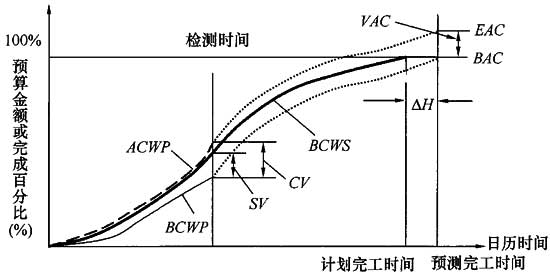 |
Figure 1 Earned value curve
|
In Figure 1: CV=BCWP-ACWP. Since the two parameters are calculated based on completed work, the difference between the two parameters reflects the cost deviation of the project progress.
CV=0, which means that the actual consumption cost is consistent with the budget cost (on budget);
CV>0, which means that the actual consumption cost is lower than the budgeted cost (under budget);
CV<0, indicating that the actual consumption cost is higher than the budget cost, that is, over budget.
SV= BCWP-BCWS. Since the two parameters are calculated based on the budget value, the difference between the two reflects the progress deviation of the project.
SV=0, indicating that the actual progress is in line with the planned progress (on schedule);
SV>0, indicating that the actual progress is ahead of the planned progress (ahead);
SV<0, indicating that the actual progress is behind the planned progress (behind).
Using earned value management technology to comprehensively control costs and schedules, it can also predict trends based on current schedules and cost deviations through cause analysis, and predict schedules and costs at the end of the project.
BAC (budget at completion) is the project completion budget;
EAC (estimate at completion) is the estimated project completion estimate;
VAC (variance at completion) is the cost deviation when the project is completed;
VAC=BAC-EAC.
2.0.9 Project implementation is the process of executing the project plan and forming the project product. In this process, a large amount of work of the project management team is organization and coordination. The project implementation is carried out in accordance with the project plan.
2.0.10 Project control is to prevent and detect deviations from the established plan, and take corrective measures. Usually, the control standard is specified in the project plan, such as the progress and cost control standard in the earned value management technology (the budget cost of the planned work BCWS). Generally, only when the scope of the project changes, the control baseline is allowed to change. The main controls of EPC contracting projects include comprehensive change control, scope change control, quality control, risk control, cost control, and schedule control.
2.0.11 Project closing includes two aspects: one is the closing of the contract, completing all the work and final accounts stipulated in the contract, and resolving all outstanding issues; the second is managing the closing, collecting, organizing and filing project documents, summarizing experience and Lessons learned, evaluate project implementation effects, and provide references for future projects.
2.0.12 According to my country's basic construction procedures, it is generally divided into two stages: preliminary design and construction drawing design. For projects with complex technology and lack of design experience, they shall be carried out in three stages: preliminary design, technical design and construction drawing design as designated by the competent authority. In order to achieve design procedures and methods in line with international standards, some engineering projects have adopted the design procedures and methods of developed countries. The design stage is divided into three stages: process (plan, conceptual) design, basic engineering design and detailed engineering design. The depth and design The finished product is different from the domestic preliminary design and construction drawing design. Generally, domestic engineering projects are designed according to the in-depth regulations of preliminary design and construction drawing design, and foreign-related projects can be designed in accordance with international practices when the project developer requires it.
2.0.13 Purchasing in a broad sense includes the procurement and design of equipment and materials, construction and labor procurement. Purchasing in this specification refers to the procurement of equipment and materials, and the procurement of design, construction, labor and lease is called subcontracting.
2.0.15 Test run is expressed differently in different fields, such as test run, start-up, commissioning, linked test run, complete (or whole) test run, joint debugging and joint test, completion test and post-completion test.
2.0.17 Project schedule control is based on the project schedule plan as the control benchmark. Through regular schedule performance measurement, schedule deviations are calculated, the reasons for deviations are analyzed, and corresponding corrective measures are taken. When there is a major change in the scope of the project or a major schedule deviation occurs, the schedule can be adjusted after approval.
2.0.18 The project cost referred to in this specification refers to the cost of the EPC contracting project, and its scope only includes the scope agreed in the contract, and does not include the cost borne by the project developer outside the scope of the contract.
2.0.19 Project cost control is based on the project cost budget. Through regular cost performance measurement, cost deviations are calculated, the reasons for deviations are analyzed, and corresponding corrective measures are taken. When the scope of the project changes significantly or major cost deviations occur, the project cost budget can be adjusted upon approval.
2.0.20 Project quality plan refers to the planning of project quality management in order to achieve the objectives of the project. It includes the formulation of project quality objectives, the determination of the objectives of the proposed quality system and the activities required by it.
2.0.21 The purpose of project quality control is to take certain measures to eliminate quality deviations and pursue zero quality defects. Project quality control needs to run through the entire process of project quality management.
2.0.2.24 Project risk exists throughout the life of the project. In addition to the general risk characteristics, due to the one-time, unique, temporary and openness of the project, the risk characteristics of different projects Each is different. Project risk management needs to emphasize the effective management of project organization, project risk, risk management dynamics and various stages of the process.
2.0.25 Project risk management is a project in itself, with clear project objectives and work content.
2.0.29 The conclusion of the general project contract is the responsibility of the general project contractor.
2.0.31 Subcontract in a broad sense refers to a contract signed by a EPC contracting enterprise to subcontract part of the project or service to other organizations in order to complete the general project contract. There may be design subcontracts, procurement subcontracts, construction subcontracts, and commissioning subcontracts, all of which belong to the subcontracts of the general project contract.
2.0.32 The defect liability period should generally be 12 months, and the longest period should not exceed 24 months. When the defect liability period expires, the project developer shall return the warranty deposit or letter of guarantee to the project contractor in accordance with the contract.
3 Organization of project EPC contract management
3.2 Appointment of project manager and establishment of project management team
3.2.2 The establishment of the project management team should include the following main contents:
Combining the characteristics of the project, determine the organizational form, and manage the project through the establishment of a design team, a procurement team, a construction team, and a commissioning team.
3.4 Position setting and management of the project management team
3.4.1 The safety manager here refers to the HSE manager, and the safety engineer refers to the HSE engineer here. HSE is the English abbreviation of Health, Safety and Envi-ronment.
3.4.2 The post setting of the project management team should meet the needs of the project and clarify the responsibilities, authorities and assessment standards of each post. The responsibilities of the main positions of the project management team shall meet the following requirements:
1. Project manager
The project manager is the person in charge of the EPC contracting project, and is responsible for fulfilling the project contract on behalf of the EPC contracting company, responsible for the planning, organization, leadership and control of the project, and responsible for the quality, safety, cost, and schedule of the project.
2. Control Manager
According to contract requirements, assist the project manager to formulate the overall project schedule and cost management plan. Coordinate with other functional managers to organize the preparation of schedule plans for design, procurement, construction and commissioning. Comprehensively manage and control the progress, costs, equipment and materials of the project, guide and manage the work of project control professionals, and review relevant output documents.
3. Design manager
According to the contract requirements, execute the project design execution plan, be responsible for organizing, guiding and coordinating the design work of the project, organize the design work according to the contract requirements, and manage and control the project design progress, quality, cost and safety.
4. Purchasing Manager
According to the requirements of the contract, implement the project procurement implementation plan, be responsible for organizing, guiding and coordinating the procurement of the project, and handling the procurement-related matters and the relationship with the suppliers. Complete the procurement requirements of the project contract for technology, quality, safety, cost, and schedule, as well as the goals and tasks of the project EPC contracting company for procurement cost control.
5. Construction manager
According to the contract requirements, execute the project construction execution plan, be responsible for the construction management of the project, and monitor the construction quality, safety, cost and progress. Responsible for the coordination, supervision and management of project subcontractors.
6. Commissioning Manager
According to contract requirements, implement the project commissioning execution plan, organize the implementation of project commissioning management and services.
7. Financial Manager
Responsible for the financial management and accounting of the project.
8. Quality Manager
Responsible for organizing the establishment of the project quality management system and ensuring effective operation.
9. Security Manager
Responsible for organizing the establishment of the project's occupational health and safety management system and environmental management system, and ensuring effective operation.
10. Commercial Manager
Assist the project manager, responsible for organizing the signing of the project contract and the management of the project contract.
11. Administrative Manager
Responsible for project management, including office, administration, and human resources.
3.6 Responsibilities and authority of the project manager
3.6.1 The responsibilities of the project manager shall be specified in the management system of the EPC contracting enterprise, and the responsibilities of the project manager in a specific project shall be specified in the project management objective responsibility statement.
4 Project planning
4.1 General provisions
4.1.1 Through the planning activities of the EPC contracting project, the project management plan and implementation plan are formed.
The project management plan is an important internal document for the EPC contracting enterprise to implement and manage the EPC contracting project, and is the basis and important basis for the preparation of the project implementation plan. The project implementation plan is the concrete and deepening of the realization of project goals. Develop work points and schedule control points for the project's resource allocation, cost, schedule, internal and external interfaces, and risk management. Usually the project implementation plan needs to be reviewed and confirmed by the project developer. According to the actual situation of the project, the content of the project management plan can also be incorporated into the project implementation plan.
4.1.2 The project planning content needs to reflect the strategic requirements of corporate development, clarify the position of the project in the realization of corporate strategy, and clarify the work objectives, management principles, and management of the project management team through analysis and research on various risks of the project Basic procedures and methods.
4.2 Planning content
4.2.1 In the process of project implementation, the goals and requirements in terms of technology, quality, safety, cost, schedule, occupational health and environmental protection are interrelated and mutually restrictive. In project planning, comprehensive consideration and overall coordination should be carried out in accordance with the actual situation of the project. Since the main basis of project planning is the contract, the output of the project planning must meet the contract requirements.
4.2.2 Project planning shall include the following main contents:
4. The resource allocation plan is to determine the types and quantities of human resources, equipment, materials, technology, funds, and information needed to complete the project activities. The resource allocation plan is prepared according to the project work breakdown structure. The allocation of resources plays a key role in the implementation of the project. According to the project objectives, the EPC contracting company shall allocate qualified personnel, sufficient facilities and financial resources for the project to ensure that the project is implemented in accordance with the contract requirements.
5. The formulation of project coordination procedures and regulations is an important part of project planning. The communication between the project management team and relevant project stakeholders needs to be determined during the project planning stage to ensure timely and accurate information communication during project implementation.
4.3 Project management plan
4.3.1 The project manager needs to organize the project functional manager to compile the project management plan in accordance with the contract and the general requirements of the project EPC contracting enterprise management. The management plan needs to reflect the company's requirements for project implementation and the project manager's overall plan and implementation plan for the project. The plan is an internal document of the company and is not issued to the outside world.
4.3.3 The content listed in this article is the basic content of the project management plan, and each industry can make adjustments according to the characteristics of the industry and the scale of the project. The project management plan needs to describe the tax planning and organization mode of the project.
4.4 Project implementation plan
4.4.1 The project implementation plan is the specific measures and means to achieve the project contract goals, project planning goals and enterprise goals, and it also reflects the project manager and project management team's implementation of the project management requirements of the EPC contracting enterprise. The project implementation plan shall be compiled by the project manager organized by the project management team personnel after the project management plan is approved. The project implementation plan must be operable.
4.4.2 The preparation basis of the project implementation plan shall include the following main contents:
2. The content of the project management objective responsibility statement is formulated according to the characteristics of each industry and enterprise. Projects that implement the project manager responsibility system need to sign a project management target responsibility letter. The overall requirements of the enterprise management are the specific requirements of the EPC contracting enterprise management for the project implementation goals, and these requirements should be included in the project implementation plan.
3. The basic information of the project includes contracts, approval documents, etc.
4.4.3 The specific content of the project implementation plan:
1. Overview:
1) Brief introduction of the project;
2) Project scope;
3) Contract type;
4) Project characteristics;
5) Special requirements.
When there are special requirements, special requirements shall be included.
2. Overall implementation plan:
1) Project goal;
2) Organizational form of project implementation;
3) Division of project phases;
4) Project work breakdown structure;
5) Project implementation requirements;
6) Project communication and coordination procedures;
7) Requirements for the work and documents of each stage of the project;
8) Project subcontracting plan.
3. Key points of project implementation:
1) Key points of engineering design implementation;
2) Key points of procurement implementation;
3) Key points of construction implementation;
4) Key points of commissioning implementation;
5) Key points of contract management;
6) Essentials of resource management;
7) Key points of quality control;
8) Key points of progress control;
9) Key points of cost estimation and control;
10) Key points of safety management;
11) Key points of occupational health management;
12) Key points of environmental management;
13) Communication and coordination management points;
14) Key points of financial management;
15) Key points of risk management;
16) Key points of document and information management;
17) Reporting system.
4. The preliminary project schedule shall determine the schedule control points for the following activities:
1) Collect relevant original data and basic information;
2) Publish project management regulations;
3) Publish the project plan;
4) Publish the project schedule;
5) Publish the engineering design execution plan;
6) Publish the project procurement implementation plan;
7) Publish the project construction execution plan;
8) Publish the execution plan of the project commissioning;
9) Complete the internal project cost estimate and budget of the EPC contracting enterprise, and publish the project cost schedule.
5 Project design management
5.1 General provisions
5.1.4 Incorporating procurement into the design process is one of the important features of the design of EPC contracting projects. The design generally includes the following tasks in the equipment and material procurement process:
1. Propose purchase requisitions and inquiry technical documents for equipment and material procurement;
2. Responsible for providing technical evaluation opinions on the manufacturer's quotation;
3. Participate in manufacturer coordination meetings, participate in technical clarification and negotiation;
4. Review and confirm the preliminary confirmation drawings and final confirmation drawings returned by the manufacturer;
5. During the equipment manufacturing process, assist in purchasing and handling related design and technical issues;
6. Participate in the inspection of key equipment and materials.
5.2 Design execution plan
5.2.1 The design execution plan is the result of project design planning and an important management document.
5.2.3 The content of the design execution plan can be adjusted according to the specific conditions of the project.
5.3 Design and implementation
5.3.1 The control target of the design execution plan refers to the main control indicators and requirements set in the design execution plan related to contract project technical management, quality management, safety management, cost management, schedule management and resource management.
5.3.2 The basic data and materials of project design are compiled on the basis of the basic data of the project, which is an important basis for project design and construction. Different project contracts require different design basic data and materials. Generally include the following main content:
1. Field data (including meteorological, hydrological, engineering geological data and other field data);
2. Analysis of raw material characteristics and product standards and requirements;
3. Design conditions of boundary area contacts;
4. Design conditions for public systems and auxiliary systems;
5. Principles and requirements for hazardous materials and waste disposal;
6. Designated standards, norms, procedures or regulations;
7. Available engineering facilities and site construction conditions, etc.
5.3.3 The design coordination procedure is an integral part of the project coordination procedure, which refers to further clarifying the relationship between the EPC contractor and the project contractor in terms of design work, contact methods, and report approval on the basis of the contract. system. The design coordination procedure generally includes the following main contents:
1. Design management contact information and counterparts in charge of both parties;
2. The project developer shall provide the basic project materials and the content of the project design data required for the design, and specify the time and method of provision;
3. The content of unconventional practices adopted in the design;
4. The content that the project developer needs to review, approve or approve in the design;
5. Requirements for sending design drawings and documents to the project contractor and the construction site, listing the content, time, number of copies and sending methods of the drawings and documents, as well as the packaging form, logo, recipient name and address of the drawings and documents, etc.;
6. Determine the content and quantity of spare parts according to the contract;
7. The scope of review and approval procedures for purchase requisitions for equipment and materials;
8. Carry out design change management in accordance with contract change procedures.
Changes include two types of project contractor changes and project changes. The change application includes the content of the change, the reason, the scope of influence, and the approval requirements.
5.3.4 Design review is mainly to review the design technical plan, there are many ways, generally divided into three levels:
The first level: the major design technical schemes in the project are reviewed by the enterprise organization;
Level 2: The comprehensive design technical plan of the project is reviewed by the project management team;
Level 3: The professional design technical plan is reviewed by the department where the major belongs.
The project design review process shall meet the requirements of the design review process of the EPC contracting enterprise.
5.3.6 In order to make the design documents meet the specified depth requirements, the following design inputs need to be reviewed.
1. Preliminary design or basic engineering design:
1) Approval documents for the preliminary work of the project;
2) Project contract;
3) Standard specifications to be adopted;
4) Other opinions and requirements of the project developer and related parties;
5) Project implementation plan and design implementation plan;
6) Unified regulations for engineering design;
7) Relevant regulations and successful technology accumulation within the project EPC contracting enterprise.
2. Construction drawing design or detailed engineering design:
1) Approved preliminary design documents;
2) Project contract;
3) Standard specifications to be adopted;
4) Other opinions and requirements of the project developer and related parties;
5) Internal review opinions;
6) Project implementation plan and design implementation plan;
7) Supplier drawings and documents;
8) Unified regulations for engineering design;
9) Relevant regulations and successful technology accumulation within the EPC contracting enterprise.
5.3.7 Except for special requirements, the equipment and materials used in the design shall not be restricted or designated for specific patents, trademarks, brands, places of origin or suppliers.
5.3.8 Before construction, organize design clarification or training to explain the design intent, explain the design documents, and clarify the design requirements for construction technology, quality, safety and standards. Find and eliminate the hidden quality hazards in the drawings, promptly negotiate and solve the existing problems, and save the corresponding records.
5.4 Design control
5.4.2 The design quality should be controlled in accordance with the requirements of the project quality management system, and control measures should be formulated. The design manager and the person in charge of each profession should fill in the required quality records and feed back the project design quality information to the functional department of the EPC contracting enterprise. Design quality control points should include the following main contents:
3. The control of design planning includes organization, technology and conditional interface relations.
5.4.3 The design change procedure includes the following main contents:
1. According to the requirements of the project or the instructions of the project developer, propose a solution for design changes;
2. Evaluate the technical feasibility, safety and applicability of the design changes instructed by the project developer;
3. After the design change is proposed, the impact of cost and schedule will be evaluated, and the design manager will review it and report it to the project manager for approval;
4. Assess the technical feasibility, safety and applicability of design changes;
5. Explain the favorable or unfavorable impact of the implementation change on the performance of the contract;
6. Implement confirmed design changes.
5.4.5 The purchase requisition documents need to be proposed by the designer, confirmed by the professional person in charge and the design manager, and submitted to the control personnel for organization review. After the review is passed, it will be submitted for purchase as the basis for purchase.
5.5 Design finishing
5.5.1 Relevant documents required to close the contract generally include:
1. As-built drawing;
2. Design change documents;
3. Operation instruction manual;
4. The revised approved estimate;
5. Other design materials, documentation, etc.
5.5.3 The experience and lessons of the project design are fed back to the relevant functional departments of the EPC contracting enterprise for continuous improvement.
6 Project procurement management
6.2 Procurement procedures
6.2.1 The procurement work shall be implemented according to the following procedures:
1. The procurement execution plan includes the procurement schedule, logistics plan, inspection plan and material control plan.
2. Purchase:
1) Purchasing can be carried out by means of bidding, price inquiry, competitive negotiation and single source procurement.
2) Purchasing according to the inquiry and comparison method, the purchasing engineer shall prepare the inquiry document according to the project's requirements for equipment and materials in accordance with the standardized format established by the EPC contracting enterprise of the project. In addition to technical, quality and business requirements, the inquiry documents can add relevant management requirements as needed, so that the supplier's supply behavior can meet the needs of project management.
The inquiry document shall include two parts: technical document and commercial document.
Technical documents are prepared according to the purchase request documents submitted by the design, including: equipment, material specifications or data sheets, design drawings, purchase instructions, applicable standard specifications, drawings to be submitted by suppliers, list of materials and schedule requirements, etc.
Commercial documents include: inquiry letter, quotation instructions, basic conditions of project procurement, requirements for packaging, transportation, delivery and service, quotation response letter and business quotation form template, etc.
Purchasing by inquiry and comparison is carried out according to the following procedures: conduct supplier pre-qualification, confirm qualified suppliers, compile the list of project inquiry suppliers; prepare inquiry documents; implement inquiry and accept quotation; organize quotation review; and supply when necessary Clarification; sign a purchase contract or order.
3. Expediting includes expediting in the office and on-site.
4. Inspection includes factory supervision and factory inspection.
5. Transportation and delivery include the packaging method agreed in the contract, transportation supervision and delivery.
6. Warehousing management includes unpacking inspection, warehouse warehousing management and non-conforming product disposal.
7. On-site service management includes procurement technical services, handling of supply quality issues, and coordination of supplier expert services.
8. Procurement closing includes order closing, document filing, remaining material processing, supplier evaluation, preparation of procurement completion report, and project procurement summary.
6.3 Procurement execution plan
6.3.3 The procurement execution plan shall include the following main contents:
3. In general equipment procurement bidding, the bid section is called the bid package.
Centralized procurement refers to the centralized procurement management method within the same enterprise or within the same enterprise group, that is, to reduce procurement costs by centralized procurement of the same type of materials.
6.4 Purchase
6.4.1 Purchasing is the process from accepting the requisition documents to issuing the order.
6.4.5 The content and format of the purchase contract or order shall be prepared by the EPC contracting company.
6.5 Expediting and inspection
6.5.1, 6.5.2 Expedited delivery is to coordinate and urge the supplier to deliver documents and goods according to the schedule agreed in the procurement contract.
Expediting refers to a series of urging activities taken during the period from the conclusion of the purchase contract or order to the delivery of the goods in order to prompt the supplier to fulfill the contractual obligations and submit the supplier's documents, drawings, and final products on time.
The main point of the expediting work is to find out the existing or potential problems in the delivery schedule in time, report in time, and urge the supplier to take necessary remedial measures, or take effective financial control and other control measures to prevent schedule delays and cost overruns. When the delivery schedule of a certain order is delayed, the necessary coordination and control measures are adopted to control the impact on the project schedule to a minimum.
The level of expediting is generally divided into three levels, A, B, and C. Each level requires a corresponding expediting method and frequency. The equipment and materials with the A-level expedited expedition are generally expedited in the factory every 6 weeks, and expedited in the office every 2 weeks. The equipment and materials with the B-level expedited expedition are generally expedited in the factory every 10 weeks, and expedited in the office every 4 weeks. For equipment and materials with a C-level expedited expedition, the in-plant expedition is generally not required, but the expedited expedited by the office is required on a regular basis, and the expediting frequency depends on the specific circumstances. The meeting urges to be held regularly or irregularly depending on the supply status.
6.5.4 Inspection is the conformity evaluation through observation and judgment, and when necessary, combined with measurement and test.
Inspection is a key link in the quality control of equipment and materials. In order to ensure that the quality of equipment and materials comply with the provisions and requirements of the procurement contract, and to avoid affecting the project schedule and cost control due to quality issues, the project procurement team needs to conduct inspections or supervision during the manufacturing process of equipment and materials, and inspections before leaving the factory.
The inspection work should start from the purchase of raw materials, including material inspection, process inspection, intermediate control point inspection and intermediate product test, strength test, compactness test, complete machine test, surface treatment inspection, transportation package inspection and commodity inspection, etc. .
The inspection methods can be divided into abandonment inspection (inspection-free), data review, intermediate inspection, workshop inspection, final inspection and project site inspection.
6.5.6 Inspectors shall compile factory supervision and factory inspection reports according to regulations. The inspection report should include the following main contents:
5. Inspection records include inspection process and target records, document review records, and records of major items that have not been witnessed or proven. When necessary, live photos and sketches are required.
7. In the inspection conclusion, for the problems that do not meet the requirements of the contract, the content of the non-conforming items shall be listed and the rectification of the non-conforming items shall be explained. If there are non-conformities that cannot be corrected or eliminated during the inspection process, the project manager shall organize relevant professionals to conduct demonstrations and draw conclusions.
6.6 Transportation and delivery
6.6.1 Transportation is the activity of safely transporting the purchased goods to the place agreed in the contract as planned.
Transportation business refers to the transportation, insurance, and delivery of goods in the process from the delivery location specified in the purchase contract or order to the construction site or designated warehousing specified in the contract after the equipment and materials provided by the supplier are completed and accepted.
6.6.2 The packaging and transportation of equipment and materials must meet the purchase contract. In the purchase contract, it is necessary to include packaging regulations, marking standards, multiple loading and unloading and handling, and transportation safety and protection requirements.
6.6.3 Over-limit equipment refers to equipment whose total weight, total length, total width or total height after packaging exceeds the relevant regulations of the country or industry.
The following main contents should be paid attention to in the transportation of over-limit equipment:
1. Obtain accurate transport packaging drawings, loading drawings, and transportation requirements for over-limit equipment from the supplier. Investigate and research the passing roads (railways, highways), bridges and culverts, and formulate special transportation plans for over-limit equipment or commission transportation plans.
2. Entrusted transportation:
1) Compile complete and accurate entrusted transportation inquiry documents;
2) Strictly implement the selection and review procedures of the carrier, and conduct on-site inspections when necessary;
3) Carry out a strict technical review of the transportation quotation, including plans and guarantee measures, and sign a transportation contract;
4) Review the transportation implementation plan submitted by the carrier.
3. Inspect the transportation packaging, reinforcement and protection of the equipment.
4. When necessary, supervision of loading, unloading and/or transportation is required.
5. When necessary, check the reinforcement of bridges, culverts and roads along the way, and implement the port lifting capacity and operation plan.
6. Check the completeness and validity of shipping documents.
6.6.4 International transportation refers to the trade term used in accordance with the import contract signed with the foreign project subcontractor (supplier or carrier). Use various means of transportation to carry out international cargo transportation from the port of shipment to the destination port corresponding to the trade terms, and go through the corresponding procedures in accordance with the scope of responsibility specified in the trade terms used, such as import declaration, commodity inspection and insurance. In the international procurement and international transportation business, we mainly use the delivery on board (FOB), cost plus freight (CFR), cost plus insurance and freight (CIF), delivery carrier (FCA), and freight carrier (FCA), which are commonly used in my country’s foreign trade. Trade terms such as freight paid to (CPT), freight and insurance paid to (CIP).
6.6.6 According to the different types of equipment and materials, the receiving work includes the following main contents:
1. Check the shipping documents;
2. Check and accept the quantity (number of pieces);
3. Check that the goods are consistent with the shipping documents;
4. Check the external packaging and the appearance quality and identification of bare equipment and materials;
5. Check the accompanying drawings and data item by item against the list, and record them.
6.8 Warehouse management
6.8.1 The storage management can be managed by the purchasing team or the construction team. Corresponding management institutions and positions can be established.
6.8.2 Unpacking inspection is based on the contract to determine the scope and content of the unpacking inspection. The unpacking inspection of imported equipment and materials shall be implemented in accordance with relevant national laws and regulations.
6.8.3 Unpacking inspection needs to check whether the appearance, quantity and random documents of the equipment, materials, spare parts and special tools are complete according to the contract, and make a record.
7 Project construction management
7.1 General provisions
7.1.2 The department responsible for the construction management of the EPC contracting company sends construction managers and construction management personnel to the project management team, and accepts the management of the dispatching department and project manager during the project implementation process, in the form of meeting the requirements of project matrix management , To achieve the goal management of project construction.
7.2 Construction execution plan
7.2.4 The project management team strictly controls major changes in the engineering design and construction plan during the construction process. These changes will have a greater impact on the construction execution plan. The scope and extent of the impact need to be reviewed in a timely manner. When the construction execution plan needs to be adjusted, the approval procedure must be re-performed in accordance with the regulations.
7.3 Construction schedule control
7.3.5 The construction team adopts regular (weekly or monthly) inspections on the construction schedule, grasps the progress deviation, analyzes influencing factors, and provides a monthly construction progress report in accordance with regulations. The report includes the following main contents:
1. Summary of implementation of construction progress;
2. Actual construction progress (chart);
3. Changes, claims and payment of construction costs that have occurred;
4. Schedule deviation and cause analysis;
5. Measures to solve deviations and problems.
7.4 Construction cost control
7.4.1 The project management team needs to plan the construction scope and decompose the corresponding work structure, and then make a resource allocation plan to determine the type, quantity, specification, quality level and investment time of the resources required for various (item) activities within the construction scope (Period), etc., and serve as the basis for estimating construction costs and determining construction cost control (payment).
7.4.3 The project management team formulates and controls the construction cost payment plan according to the construction subcontract agreement and the construction schedule plan. It is usually carried out as follows:
1. Carry out construction cost estimation and determine the basis of planned cost control. When estimating, it is necessary to consider the impact of the economic environment (such as inflation, tax rates, exchange rates, etc.). When the estimation involves major uncertain factors, measures shall be taken to reduce the risk, and an emergency reserve fund for risk shall be reserved. Preliminarily determine the basis of planned cost control.
2. Develop a construction cost control (payment) plan. On the basis of resource allocation and cost estimation, in accordance with the prescribed cost accounting and review procedures, the relevant implementation conditions and constraints (such as allowable limits, emergency reserves, etc.) are clarified and written documents are formed.
3. Assess the implementation of costs. Check the planned cost control benchmark, confirm the actual deviation from the benchmark cost, and do a good job of analysis and evaluation. Take measures to influence and correct the basic factors that produce deviations, so that construction costs can be controlled.
4. Monitor internal and external factors affecting construction costs, predict and forecast changes in costs, and make reasonable adjustments in accordance with prescribed procedures to ensure the normal progress of the project.
7.5 Construction quality control
7.5.1 The quality management of special processes generally meets the following requirements and records are kept:
1. Identify and define special processes in the quality plan, or require the project subcontractor to identify, and the project management team will confirm it;
2. Prepare or review special process work instructions in accordance with relevant procedures;
3. Set up quality control points to monitor special processes, or monitor the control of project subcontractors;
4. Supervise the implementation of reconfirmation due to changes in construction conditions.
7.5.2 Supervise the quality of equipment and materials to ensure that qualified equipment and materials are used in engineering. The quality control of equipment and materials generally meets the following regulations, and records are kept:
1. The equipment and materials entering the site shall be inspected and marked in accordance with relevant standards and witness sampling regulations, and the equipment and materials that have not been inspected or unqualified shall be isolated, marked and disposed of in accordance with the regulations;
2. To control the quality of equipment and materials purchased by project subcontractors, and ensure that qualified equipment and materials are used in the project;
3. The quality control of the equipment and materials provided by the project contractor shall be carried out in accordance with the contract, and the qualified equipment and materials must be used in the project.
7.5.5 Use appropriate methods for statistics, analysis and comparison of the data obtained from the measurement and monitoring of the quality of the construction process, identify opportunities for continuous quality improvement, determine improvement goals, and review the suitability of corrective measures. Take appropriate measures to ensure that this process continues and effectively.
7.5.6 Through the construction subcontract, clarify the quality responsibilities of the project subcontractor, and review the consistency between the quality plan of the project subcontractor and the project quality plan.
7.5.8 Project quality acceptance includes construction process quality acceptance, project quality pre-acceptance and completion acceptance.
7.5.9 The project quality record is the direct evidence reflecting the quality results of the construction process and an important basis for judging the quality and performance of the project. Therefore, maintaining the integrity and authenticity of quality records is an important part of project quality management. It is necessary to organize or supervise the project subcontractor to do a good job in the collection, sorting and filing of project completion data. At the same time, review the quality of the completed drawings and documents provided by the project subcontractors.
7.6 Construction safety management
7.6.2 The purpose of the construction safety management plan of the project management team is to determine the targeted safety technology and management measures plan to control and reduce construction unsafe factors and achieve the construction safety goal. The planning process includes the identification of construction hazards, risk assessment and the formulation of risk response measures.
1. According to the characteristics and conditions of project construction, identify the construction hazards that need to be controlled. They involve:
1) Normal, periodic and temporary, emergency activities;
2) The activities of all personnel entering the construction site;
3) All materials, facilities and equipment in the construction site.
2. Appropriate methods are used to evaluate all identified construction hazards based on the possibility of foreseeable dangerous situations and the severity of consequences, and determine major construction hazards based on the risk assessment results.
3. Risk response measures are determined according to the degree of risk:
1) Control general risks through current operating procedures and regulations;
2) In addition to implementing current operating procedures and regulations to control major risks, special construction plans or special safety measures need to be formulated to control them.
7.6.7 Construction records include construction safety records.
7.7 Construction site management
7.7.1 The preparatory work before the start of on-site construction generally includes the following main contents:
1. On-site management organization and personnel;
2. On-site working and living conditions;
3. Documents, materials, management procedures and rules and regulations required for construction;
4. Equipment, materials, material supply and construction facilities, tools and equipment preparation;
5. Confirm the construction cost of the project;
6. Check the conditions for construction personnel to enter the site and carry out work as planned;
7. The implementation of conditions that require social resources to support.
Usually, important preparations need to be incorporated into the construction execution plan as the basis for construction management.
7.7.4 The project management team needs to assign a special person to manage on-site sanitation and epidemic prevention work, and check the effectiveness of occupational health work and first aid facilities.
8 Project commissioning management
8.1 General provisions
8.1.1 The responsibilities and obligations of the project management team in the commissioning stage are to provide the project contractor with guidance and services in the commissioning process in accordance with the scope and objectives agreed in the contract. For turnkey projects, the project contractor shall be responsible for the commissioning according to the contract.
8.1.3 Preparations for commissioning include: manpower, machinery, materials, energy, organizational systems, permits, safety, occupational health and environmental protection, and the preparation of documents and materials. The materials that need to be prepared for commissioning include: operation manual, maintenance manual and safety manual, etc., items entrusted by the project developer and description of existing problems.
8.2 Trial run execution plan
8.2.1 In the initial stage of the project, the commissioning manager shall organize the preparation of the commissioning execution plan according to the contract and the project plan.
8.2.2 The commissioning execution plan includes the following main contents:
1. General description: project overview, preparation basis, principles, commissioning goals, progress and commissioning steps, and propose solutions to problems that may affect the execution plan of the commissioning;
2. Organization: Propose relevant units to participate in the commissioning, clarify the scope of responsibility of each unit, propose a commissioning organization and command system, and clarify the responsibilities and division of labor of each post;
3. Schedule: trial run schedule;
4. Resource plan: including plans for personnel, machinery, materials, energy equipment and emergency facilities and equipment;
5. Cost plan: the preparation and use principle of the commissioning cost plan, the commissioning cost shall be calculated according to the commissioning period, commissioning load, commissioning output, raw material, energy and labor consumption determined in the plan;
6. Training plan: training scope, methods, procedures, time and required costs, etc.;
11. The division of responsibilities between the project developer and related parties: usually led by the project developer, a unified command system is established to clarify the responsibilities and obligations of each related party.
8.2.3 In order to ensure the normal implementation of the commissioning execution plan and the realization of the target tasks, the project management team and the commissioning manager clarify the input requirements of the commissioning (including the completion standards and requirements for the construction and installation, and carefully check the implementation performance) and meet Output requirements (to meet stable production or use, provide qualified production evaluation index records and on-site evidence), so that commissioning becomes the prerequisite and basis for formal production or use.
8.3 Implementation of commissioning
8.3.1 The commissioning manager shall be responsible for organizing or assisting the project contractor to prepare the commissioning plan in accordance with the contract. The commissioning plan should include the following main contents:
2. The preparation of the commissioning plan is based on the following principles:
1) Prepare the overall plan for commissioning, including the main body of production, supporting and auxiliary systems, and stage commissioning arrangements;
2) Carry out comprehensive coordination according to the actual situation, and reasonably arrange the supporting and auxiliary systems to be put into operation first or simultaneously to ensure the continuity and stability of the main body's commissioning;
3) Make overall arrangements in accordance with the actual situation, and promptly propose measures and methods to solve the problem in order to ensure the realization of the planned goals;
4) When using third-party technology or inviting a demonstration operation team, seek the opinions of the patent vendor or the demonstration operation team in advance and form a written document to guide the normal progress of the commissioning.
8. 9. The operational arrangements and safety and occupational health requirements of environmental protection facilities shall include requirements for emergency plans.
9 Project Risk Management
9.2 Risk identification
9.2.2 Project risk identification generally adopts methods such as expert investigation method, initial checklist method, risk investigation method, empirical data method and graphic method.
9.3 Risk assessment
9.3.2 Project risk assessment generally adopts methods such as survey and expert scoring method, analytic hierarchy process, fuzzy mathematics method, statistics and probability method, sensitivity analysis method, fault tree analysis method, Monte Carlo simulation analysis and influence diagram method.
9.4 Risk control
9.4.2 Project risk control generally adopts methods such as audit inspection method, cost deviation analysis method and risk chart representation.
10 Project progress management
10.1 General provisions
10.1.3 The application of earned value management technology in project schedule management is mainly to control schedule deviation and time deviation. The application of network planning technology in schedule management is mainly the key route method. Use to control key activities, analyze the total time difference and free time difference to control the progress. Control the progress of basic activities to control the progress of the entire project.
10.2 Schedule
10.2.1 Work breakdown structure (WBS) is a hierarchical tree structure that divides the project into manageable project work task units. The work breakdown structure of a project is generally divided into the following levels: project, single project, unit project, group code, accounting code and unit activity. The schedule is usually made at each level.
10.2.2 A schedule is not only a simple schedule, but also contains resources. According to the budget value of various resources consumed by the execution plan, the work cycle of each specific task is carried out and resource allocation is carried out. The risk analysis in the preparation of the schedule plan includes economic risks, technical risks, environmental risks, and social risks. Control measures include organizational measures, economic measures and technical measures.
The project schedule document includes the following main contents:
1. Schedule chart. You can choose to use single-code network diagrams, double-code network diagrams, time-scale network plans, and horizontal road diagrams with implicit activity logic relationships. The schedule chart should include measurement benchmarks, schedule benchmark curves and resource allocation.
2. Instructions for the preparation of the schedule. Including the basis for the preparation of schedule plans, plan objectives, key route descriptions, resource requirements, external constraints, risk analysis and control measures.
10.2.3 The overall project schedule includes the following main contents:
1. Represents the cycle of each individual project, as well as the earliest start time, earliest completion time, latest start time and latest completion time, and indicates the connection between individual projects;
2. Indicates the earliest start time and earliest completion time of the major single project design progress, and the completion time of the preliminary design or basic engineering design;
3. Indicates the procurement schedule of key equipment and materials, as well as the delivery time of key equipment and materials to the site. Key equipment and materials mainly refer to equipment and materials with long lead times and valuable materials;
4. Indicate the earliest start time and earliest completion time of the construction of each individual project, as well as the planned bidding time of the main individual construction subcontract projects;
5. Indicates the commissioning time of each single project, as well as the power supply, water supply, steam supply and gas supply time, including the external supply time and the supply time of the internal single (public) project to other single projects.
The sub-schedule plan of a project refers to the various levels of schedule under the overall project schedule.
10.2.4 The project manager review includes the following main contents:
1. Whether the objectives and main control points specified in the contract are clear;
2. Whether the project work breakdown structure is complete and meets the requirements of the project scope;
3. Whether the cross operation between design, procurement, construction and commissioning is reasonable;
4. Whether the schedule is connected with external conditions;
5. Whether there are countermeasures and countermeasures for the impact of risk factors;
6. Whether the resource requirements proposed in the schedule can be met;
7. Whether the schedule is coordinated with the quality, safety and cost plan.
10.3 Progress control
10.3.3 The analysis of schedule deviation shall be carried out according to the following procedures:
1. The analysis of schedule deviation using earned value management technology is intuitive, simple and clear, but it cannot determine the key lines in the schedule plan, so the network plan analysis cannot be replaced by the earned value management technology.
2. When the activity lag time forecast may affect the progress, use the key activities, free time difference and total time difference in the network plan to analyze the impact on the progress.
The control principles of the schedule schedule are as follows:
1) When the planned duration is equal to the contract duration, the control of the schedule shall meet the following requirements:
① Delays in activities on key routes, adjust the duration of related activities or the logical relationship between related activities, so that the adjusted planned construction period is the original planned construction period;
② When the activity delay time is less than or equal to the free time difference, the planned construction period may not be adjusted;
③When the activity delay time is greater than the free time difference, but does not affect the planned construction period, it is handled according to the characteristics of the subsequent work.
2) When the planned construction period is less than the contract duration, if it is necessary to extend the planned construction period, it shall not exceed the contract duration.
3) It is necessary to eliminate the impact or slow down the progress when the activities are completed ahead of the reasonable arrangement of equipment, materials, funds, and human resources that affect the follow-up work.
10.3.4 The project progress execution report contains the current progress and the reasons for the deviation, and proposes corrective measures.
10.3.7 The project management team shall focus on monitoring the interface relationship between design, procurement, construction and commissioning.
1. In the interface relationship between design and procurement, implement key control on the interface progress of the following main contents:
1) Design and submit purchase documents to purchase;
2) Design technical review of quotation;
3) Purchasing the key equipment data submitted to the design;
4) Design review, confirmation and return of the manufacturer's drawings;
5) The impact of design changes on the procurement schedule.
2. In the interface relationship between design and construction, implement key control on the interface progress of the following main contents:
1) The constructability analysis of construction to design;
2) Delivery of design documents;
3) Design submission or drawing review;
4) The impact of design changes on the construction schedule.
3. In the interface relationship between design and commissioning, the key control of the interface progress of the following main contents is implemented:
1) Trial run puts forward trial run requirements for the design;
2) Design submission and commissioning operation principles and requirements;
3) Design guidance and service for commissioning, and the impact of handling design problems found during commissioning on commissioning progress.
4. In the interface relationship between procurement and construction, implement key control on the interface progress of the following main contents:
1) All equipment and materials are delivered to the site;
2) Unpacking inspection on site;
3) The impact of the treatment of problems related to equipment and material quality found during the construction process on the construction progress;
4) The impact of procurement changes on the construction schedule.
5. In the interface relationship between procurement and commissioning, focus on the interface progress of the following main contents:
1) Confirmation of materials and spare parts required for commissioning;
2) The impact of the treatment of problems related to the quality of equipment and materials found during the commissioning on the progress of the commissioning.
6. In the interface relationship between construction and commissioning, implement key control on the interface progress of the following main contents:
1) The impact on the progress when the construction execution plan and the commissioning execution plan are not coordinated;
2) The impact of the treatment of construction problems found during the commissioning on the progress.
10.3.8 The project subcontractor shall regularly report the progress of the subcontracted project to the project management team in accordance with the contract.
11 Project quality management
11.1 General provisions
11.1.3 Quality management personnel (including quality managers and quality engineers) are responsible for the formulation of the quality plan and the supervision and inspection of the implementation of the quality plan under the leadership of the project manager. The project management team establishes a quality responsibility system and assessment methods to clarify the quality management responsibilities of all personnel.
11.2 Quality plan
11.2.1 The quality plan of a small project can be incorporated into the project plan.
11.2.4 The project quality plan shall include the following main contents:
3. The required documents include standard specifications and procedures for project implementation.
4. The measures taken include the review, verification, confirmation monitoring, inspection and test activities required by the project.
Some content of the project quality plan can be quoted or supplemented on the basis of the relevant provisions of the quality system documents of the EPC contracting enterprise, but the specific requirements and process quality management of the project must be clarified.
11.3 Quality control
11.3.1 The project management team determines the control procedures or related regulations for project input, and specifies the responsibilities and requirements for the effectiveness of the input review, as well as the procedures for transmission, use and conversion within the project management team.
11.3.2 The project management team implements key quality monitoring in the interface relationship between design, procurement, construction and commissioning.
1. In the interface relationship between design and procurement, focus on the quality control of the following main contents:
1) The quality of the purchase documents;
2) Conclusion of technical review of quotation;
3) Review and confirmation of supplier drawings.
2. In the interface relationship between design and construction, focus on the quality control of the following main contents:
1) Coordination and consistency between construction requirements and constructability analysis;
2) The organization and effectiveness of design disclosure or drawing review;
3) The impact of the handling of design issues raised on site on construction quality;
4) The impact of design changes on construction quality.
3. In the interface relationship between design and commissioning, the quality control of the following main contents shall be implemented with emphasis:
1) The design meets the requirements of commissioning;
2) commissioning principles and required quality;
3) Design the quality of guidance and service for commissioning.
4. In the interface relationship between procurement and construction, focus on the quality control of the following main contents:
1) The impact of the progress and status of all equipment and materials arriving at the site on the construction quality;
2) Organization and effectiveness of on-site unpacking inspection;
3) The impact of handling problems related to equipment and material quality on construction quality.
5. In the interface relationship between procurement and commissioning, focus on the quality control of the following main contents:
1) Confirmation of materials and spare parts required for commissioning;
2) The impact of the handling of problems related to the quality of equipment and materials during the commissioning on the results of the commissioning.
6. In the interface relationship between construction and commissioning, focus on the quality control of the following main contents:
1) Coordination and consistency between the construction execution plan and the commissioning execution plan;
2) The quality of commissioning and defect repair of mechanical equipment;
3) The impact of the handling of construction problems during the commissioning on the results of the commissioning.
11.3.3 The project management team without a quality manager, the work of the quality manager is completed by the project quality engineer.
Non-conformity refers to non-conforming product of product quality, non-conformity refers to non-conformity items of management system operation.
The control of unqualified products meets the following requirements:
1. For nonconforming products found in the verification, identify, record, evaluate, isolate and dispose of them in accordance with the nonconforming product control procedures to prevent unintended use or delivery;
2. The disposition result of the non-conforming product shall be transmitted to the relevant department, and the responsible department shall analyze the cause of the non-conformity and formulate corrective measures to prevent the generation of the same or similar non-conforming products in the future;
3. When the corrective measures taken are verified to be ineffective or fail to fully achieve the expected results, the reasons need to be re-analyzed, and the next round of planning, implementation, inspection and treatment shall be carried out.
11.3.4 Quality records include: review records and reports, verification records, audit reports, inspection reports, test data, appraisal (acceptance) reports, confirmation reports, calibration reports, training records, and quality cost reports.
12 Project Expense Management
12.1 General provisions
12.1.3 Cost control, schedule control, and quality control are coordinated with each other to prevent improper response measures to cost deviations, which may affect quality and schedule, or cause greater risks in the later stages of the project.
12.2 Cost estimation
12.2.1 Estimation is the process of estimating the resources and costs required to complete the project. During the project implementation process, the initial control estimate, approved control estimate, first approved estimate and second approved estimate should usually be prepared.
It is estimated that the understanding of international practice is different from the meaning used domestically. Domestic project cost estimation is divided into feasibility study report or project proposal investment estimation, preliminary design budget and construction drawing budget. Moreover, the above estimates, estimates, and budgets usually refer to the total investment of the entire project, including other expenses borne by the project contractor, such as construction unit management fees and commissioning fees. The cost estimates for each stage of the implementation of international customary projects are estimated, and definitions are added before the estimates to show the difference, such as quotation estimates, initial control estimates, approved control estimates, and approved estimates.
The estimates and budgets referred to in this specification only refer to the expenses within the scope of the contract project, and do not include other expenses borne by the project developer.
There are the following types of international general project cost estimates:
1. Initial control estimation
The initial control estimation is a kind of approximate estimation, which is compiled by the analytical estimation method in the initial stage of process design. Under the condition that only the scale, type, and basic technical principles and requirements of the project are clarified, the project cost is analyzed and estimated based on historical data such as engineering data, curves, ratios and charts accumulated by the enterprise according to statistical methods over the years. The benchmark for cost control at the initial stage of the project.
2. Approved control estimates
The deviation range of the approved control estimate is smaller than the deviation range of the initial control estimate. In the initial stage of basic engineering design, the equipment estimation method is used to prepare. The main basis for the compilation is the determined equipment table, process flow chart and process data obtained from the process design documents published by the project, the relevant design specifications (technical regulations) and the material list in the basic engineering design, and according to the accumulation of enterprises The project experience data, etc., combined with the actual situation of the project, select and determine various cost coefficients, which are mainly used as the cost control benchmark in the basic engineering design stage.
3. First approved estimate
This estimate is compiled by the equipment detailed estimate method when the basic engineering design is completed. The deviation range of the first approved estimate is smaller than the deviation range of the approved control estimate, and is used as a cost control benchmark in the detailed engineering design stage and construction stage. The documents and materials it is based on are the design documents issued when the basic engineering design is completed. Due to the depth of the document, some bulk materials still need to use coefficients to estimate related costs.
The preparation stage of the first approved estimate and the design conditions of the preparation stage of the design budget are relatively close. For the specific preparation, please refer to the relevant domestic preliminary design budget preparation regulations.
4. Second approved estimate
This estimate is prepared by the detailed estimate method when the detailed engineering design is completed. It is mainly used to analyze and predict the final cost of the project at the completion of the project, and can be used as the basis for project construction settlement. It is relatively close to the design conditions for the preparation of construction drawing budget. The prices of equipment and materials are the prices on the order. The second approved estimate is the estimate with the smallest deviation. The preparation basis is:
1) Engineering detailed design drawings;
2) Equipment and material ordering documents, as well as various actual costs and financial documents during project implementation;
3) Enterprise quota;
4) Related national pricing regulations.
12.4 Cost control
12.4.1 Cost control is the core content of cost management for EPC contracting projects. The cost control of the EPC contracting project is not only the monitoring of the costs incurred during the construction of the project and the collection of a large amount of cost data, but more importantly, the correct analysis of various cost data and timely effective measures to achieve the ultimate project The expenses are controlled within the budget.
12.4.2 The budget is to allocate the approved control estimates to the accounting code and unit activities or work packages, and superimpose them according to the schedule plan to obtain the cost budget (baseline) plan.
The understanding of budget and international practice is also different from the meaning used in the country. Domestic budgets are used in construction drawing design; international practice usually refers to approved control estimates as budgets, and the budget refers to control estimates that are broken down according to WBS and allocated according to schedule.
12.4.3 After determining the project cost control target, it is necessary to compare the budgeted cost of the completed work with the actual cost on a regular basis (it is preferable to use monthly as the control cycle). When the actual value deviates from the budgeted value, analyze the reasons for the deviation and adopt Appropriate corrective measures to ensure the achievement of cost targets.
13 Project safety, occupational health and environmental management
13.2 Security Management
13.2.2 The project management team shall formulate a project safety management plan based on the safety management objectives of the project, and approve the implementation according to the prescribed procedures. The project safety management plan shall include the following main contents:
3. Hazard sources and the safety risks they bring are the core of project safety management. The hazards of EPC contracting projects are identified from the following aspects:
1) Routine activities of the project, such as normal construction activities;
2) Unconventional activities of the project, such as overtime, emergency repair activities, etc.;
3) All activities of personnel entering the workplace, including the activities of members of the project management team, project subcontractors, supervisors, and representatives of the project contractor and visitors;
4) All facilities in the workplace, including project-owned facilities, facilities owned by project subcontractors, leased facilities, etc.
Compiling a list of hazards can help identify hazards and take timely measures to reduce accidents. The list is compiled at the initial stage of the project. The contents of the list generally include: the name of the hazard source, its nature, risk assessment and possible consequences, and the countermeasures or measures to be taken.
The procedure of hazard identification, risk assessment and implementation of necessary measures is shown in Figure 2.
13.2.3 The project management team shall manage the implementation of the project safety management plan. Including the following main content:
1. The top management of the project EPC contracting enterprise, various departments of the enterprise and the project management team provide necessary human, technical, material, special skills and financial resources for the implementation, control and improvement of the project safety management plan;
2. Ensure that the project management team personnel and subcontractors correctly understand the content and requirements of the safety management plan.
13.2.4 Project safety management shall run through all stages of design, procurement, construction and commissioning.
|
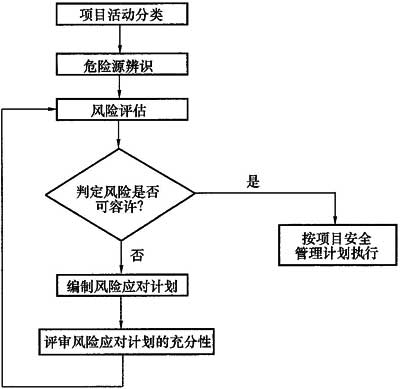 |
Figure 2 Hazard identification, risk assessment and implementation procedures
|
1. The design needs to meet the needs of safety during the operation and use of the project, as well as the needs of safe construction operation and protection, and the engineering design shall be carried out in accordance with regulations.
1) The design needs to ensure the intrinsic safety of the project, and cooperate with the project contractor to apply for special review by local security, fire protection and other agencies to ensure the safety of the project during implementation and operation;
2) The design considers the needs of construction safety operation and protection, and specifies the key parts and links related to construction safety in the design documents, and provides guidance on the prevention of safety accidents;
3) For construction projects with new structures, new materials, and new technologies, as well as projects with special structures and special equipment, measures to ensure the safety of construction workers and prevent safety accidents are proposed in the design.
2. Project procurement The safety control of equipment, materials and protective equipment purchased by oneself or subcontracted. The purchase contract includes clauses related to safety requirements and clearly stipulates the safety of supply, inspection and transportation.
3. Safety management during the construction phase should be combined with industry and project characteristics to manage factors that may affect safety during the construction process.
4. Before the commissioning of the project, the safety acceptance of each individual project shall be organized. Develop safety technical measures for commissioning to ensure the safety of the commissioning process.
14 Project Resource Management
14.1 General provisions
14.1.2 Project resource optimization is the planned pre-control of project resource management objectives and an important part of the project plan, including resource planning, resource allocation, resource combination, resource balance, and resource input timing.
14.3 Equipment and material management
14.3.2 The project management team inspects the engineering equipment and materials to be entered, and the project procurement manager is responsible for organizing the inspection and recording of the arrival status of the equipment and materials on site, and handles the handover procedures. The equipment and materials entering the site must be qualified in all aspects such as the model, appearance quality, quantity and packaging quality of the goods, and the information is complete and accurate. Effectively control the unqualified products found in the inspection and acceptance process, and effectively protect and store the equipment and materials to be inspected.
14.4 Machine management
14.4.1 Project equipment refers to the various construction equipment, trial run tools, inspection and test equipment, office equipment and other equipment resources that the project management team needs to use directly for the implementation of the project. Does not include permanent engineering facilities handed over to the project developer.
14.5 Technical Management
14.5.3 The project EPC contracting enterprise shall manage the intellectual property rights of the project, such as copyrights, patent rights, know-how, trade secrets and trademark exclusive rights, and at the same time respect and legally use the intellectual property rights of others.
14.6 Fund management
14.6.6 The project management team makes reasonable predictions on the income and expenditure of project funds, evaluates various influencing factors, adjusts project management behaviors, and avoids capital risks as much as possible.
15 Project communication and information management
15.1 General provisions
15.1.2 The use of modern information communication technology based on computer networks for project information communication does not exclude face-to-face communication and other communication methods.
15.1.4 Project information management personnel generally include information technology management engineers (IT engineers) and document management control engineers. The latter can sometimes be concurrently assumed by the project secretary.
15.2 Communication management
15.2.1 The content of project communication includes all information related to project construction. The project management team needs to do a good job of communication and coordination with relevant government authorities, and provide project information in accordance with the management requirements of relevant authorities, and handle and Statutory procedures related to construction and commissioning are approved or permitted. Do a good job of communication and coordination with social public units that are directly related to design, procurement, construction and commissioning, obtain and submit relevant materials, and go through relevant procedures and approvals.
15.2.2 The following methods and channels can be used for communication:
1. Information retrieval system: including technical documents such as file system, computer database, project management software and engineering drawings;
2. Work breakdown structure (WBS). Project communication has an important relationship with the work breakdown structure, and the work breakdown structure can be used to prepare a communication plan;
3. Information sending system: including meeting minutes, files, electronic documents, shared network electronic databases, faxes, e-mails, websites, conversations and lectures, etc.
15.3 Information Management
15.3.5 Project coding systems usually include project coding (PBS), organizational breakdown structure (OBS) coding, work breakdown structure (WBS) coding, resource breakdown structure (RBS) coding, equipment material codes, cost codes, and document codes, etc. . Project information classification considers the stability, compatibility, scalability, logic and practicality of the classification. The coding of project information considers the uniqueness, rationality, inclusiveness and scalability of the coding and is simple and applicable.
15.4 File management
15.4.1 The documents and materials of the project include the documents and materials of the subcontracted project. When signing the subcontract, it is necessary to specify the number of transfer sets, transfer time, quality requirements and acceptance criteria of the subcontracted project documents and materials. The formation of engineering data needs to be synchronized with project implementation. After the subcontracting project is completed, the project subcontractor will hand over the relevant project materials in accordance with the contract.
15.4.2 Project data, text, tables, drawings, images and other information should be stored in electronic form. Project documents with legal effect shall be stored in both paper and electronic forms.
15.5 Information security and confidentiality
15.5.2 Engineering EPC contracting companies need to formulate information security and confidentiality management procedures, regulations and measures to ensure the security of documents and information, prevent the leakage and loss of internal information and leading technology, and ensure the company’s competitive advantage in the market. Including the following main tasks:
1. Ensure the synchronization backup of the database and remote disaster backup to avoid the loss of project information and data;
2. Use firewalls, data encryption and other technical means to prevent illegal, malicious attacks, tampering or theft;
3. Control system users' permissions to prevent improper use or abuse of project data information.
16 Project contract management
16.1 General provisions
16.1.2 Engineering EPC contract management refers to the management of all activities of performance, modification, breach of contract, claim, dispute settlement, termination or termination after the contract is concluded and effective; subcontract management refers to the management of subcontracting Project bidding, bid evaluation, negotiation, contract formation, and management of all activities such as performance, change, breach of contract, claim, dispute settlement, termination or termination after it becomes effective.
16.2 Project EPC contract management
16.2.2 The management of EPC contracting should include the following main contents:
1. Completeness and validity refer to whether the composition of the contract text is complete and whether the signing of the contract meets the requirements.
2. Organizing to be familiar with and researching contract documents is an important task of the project manager in the initial stage of the project, and it is the basis for performing the contract according to law. Its purpose is to clarify and clarify the overall requirements of the contract and incorporate them into the project implementation process to avoid the risk of potential failure to meet the requirements of the project contractor.
16.2.7 The project management team and contract management personnel shall clarify and define the liability for breach of contract and/or joint liability assumed by the contract parties and related parties in accordance with the contract agreement and relevant evidence, and the result shall be formed into a written document as the loss suffered Party used to obtain evidence of compensation.
16.2.9 Project contract document management shall meet the following requirements:
2. When contract performance is interrupted, contract terminated and/or closed, the contract management personnel will do a good job of inventory, custody or transfer and filing of contract documents to meet the needs of the parties involved in the contract.
16.2.10 The contract closing work shall meet the following requirements:
1. When there is no clear stipulation in the contract, the contract closing work generally includes: collecting and sorting out the contract and all related documents, materials, records and information, summarizing experience and lessons, filing as required, and implementing formal acceptance. Obtain formal written acceptance documents in accordance with the contract.
16.3 Subcontract management
16.3.5 The project management team needs to clarify the responsibilities of various subcontract management. The responsibilities of various types of subcontract management are as follows:
1. Design: According to the contractual agreement and requirements, clarify the scope of responsibility of the design subcontracting, sign the design subcontracting contract, coordinate and supervise the contract performance, and ensure the realization of the design goals and tasks;
2. Procurement: In accordance with the contractual agreement and requirements, clarify the scope of procurement and services, sign a procurement subcontract, supervise the performance of the contract, and complete the objectives and tasks of project procurement;
3. Construction: In accordance with the contractual agreement and requirements, on the basis of clarifying the scope of construction and service responsibilities, sign a construction subcontract, supervise and coordinate the performance of the contract, and complete the construction goals and tasks;
4. Other consulting services: According to the needs of the contract, clarify the scope of service responsibilities, sign subcontracts or agreements, supervise and coordinate the performance of subcontracts or agreements, and complete the specified goals and tasks;
5. The management responsibilities of the project management team for all subcontracts are coordinated with the management responsibilities of the EPC contract. At the same time, it is necessary to perform the responsibilities and obligations of the project contractor as stipulated in the subcontract, and cooperate with the project subcontractor. Coordinate and provide necessary convenience.
16.3.6 The project management team can subcontract according to the scope, content, requirements and resource conditions of the EPC contracting project, and the subcontracting method is determined according to the actual situation of the project. If the bidding method is adopted, its main content and procedures must meet the following requirements:
1. The project management team needs to make preparations for the bidding of subcontracted projects, including:
1) According to the contract and the requirements of the project plan, formulate a subcontract bidding plan and implement the required resource allocation;
2) Determine the bidding method;
3) Organize the preparation of bidding documents;
4) Establish bid evaluation and negotiation organizations;
5) Other related bidding preparations.
2. Organize and implement bidding activities as planned, including:
1) Publish notices or invitation letters in accordance with the prescribed bidding methods;
2) Conduct prequalification or review of bidders, determine qualified bidders, and sell bidding documents;
3) Organize the clarification of bidding documents;
4) Accept bids from qualified bidders and organize bid opening;
5) Organize bid evaluation and award;
6) Issue a notice of bid winning.
16. 3.12 There are two situations for subcontract changes:
1. The project management team will issue written instructions or notices to the project subcontractors according to the project conditions and needs, requesting changes to the scope and content of the subcontracts. After review and confirmation by both parties, it constitutes a change in the subcontract, which is handled in accordance with the change procedures;
2. The project management team accepts the written rationalization proposal of the project subcontractor, and clarifies and reviews its role and impact in terms of technical performance, quality, safety maintenance, cost, schedule and operation, and after confirmation, constitutes a subcontract Changes are handled in accordance with the change procedures.
16. 3.14 The closing of the subcontract is included in the scope of the closing of the entire project contract.
17 Project closing
17.4 Project Summary
17.4.1 The project summary report shall include the following main contents:
1. Project overview and implementation effect;
2. Experience and lessons of quotation and contract management;
3. The situation of project management;
4. The quality, safety, cost, schedule control and management of the project;
5. Implementation results of design, procurement, construction and commissioning;
6. Summary of project management final data;
7. Experiences and lessons learned in project management;
8. Suggestions for work improvement.
|
|

